
Expert Support
Visit our Helpdesk
Visit our Helpdesk

A military medal framing review should begin with one question: does the display protect the medals as carefully as it presents them? A framed group may be intended for a hallway, regimental room, study or family home, but it remains a record of service. The right frame gives the medals presence without altering, obscuring or placing pressure on the originals.
For families, framing is often arranged after a bereavement or when medals have spent years in a drawer. For collectors, it may be the final stage in documenting a named group. In both cases, a good result depends on accurate arrangement, conservation-safe materials and a framer who understands that the ribbons, clasps, naming and accompanying documents all carry meaning.
A proper review is not simply about whether the finished case looks smart from across a room. It considers the medals themselves, the story they represent and how the display will age. A handsome dark frame can still be the wrong choice if the backing contains acidic material, the medals are fixed too tightly, or the glazing creates damaging heat and light exposure.
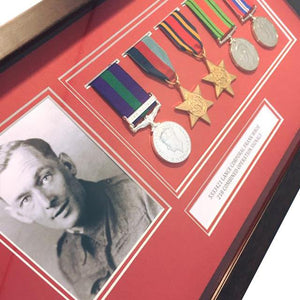
Start by deciding what belongs in the frame. A single gallantry award calls for a different treatment from a full mounted group, and a campaign group may benefit from supporting items such as a cap badge, photograph, service record copy or memorial plaque. Restraint matters. If too many unrelated objects are included, the medals lose their proper prominence and the historical record becomes confused.
The display should also reflect whether the medals are to remain wearable. If they may be needed for a parade, anniversary, remembrance service or regimental occasion, framing original medals permanently may not be practical. In that situation, consider keeping the originals correctly mounted and presenting high-quality replica medals, ribbon bars or a photographic record instead. MoD Licensed Replica Medals can be an appropriate option where a family wants a permanent display while retaining the originals for ceremonial use.
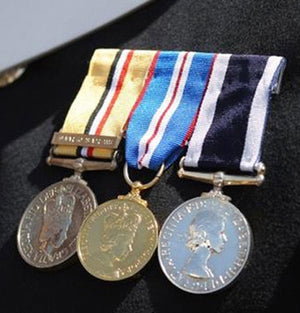
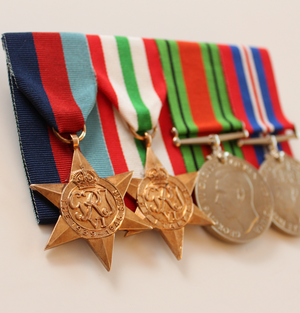
The order of wear is central to a credible presentation. British decorations, campaign medals, commemorative medals and long-service awards follow an established order of precedence. Clasps must correspond to the medal and service, while the direction of the medal faces, ribbon colours and any emblems need to be correct.
This is particularly relevant where medals have been inherited. A group may have been remounted, expanded over time or stored separately from its paperwork. Do not assume that the existing order is right because it has been worn that way previously. A specialist should review the entitlement where records, naming, ribbon details or family information suggest uncertainty.
Mounted groups deserve close attention. Court-mounted medals usually sit in a neat, formal line with the lower portion supported by a backing, while swing-mounted medals hang independently from their ribbons. Either can be framed well, but the finished display should not force a style that misrepresents how the group was intended to be worn. If the medals are already professionally mounted, it is generally better to frame the group in that form rather than dismantle it solely for appearance.
Before framing, inspect the rim or reverse naming on each medal. It can identify the recipient, rank, service number and unit, depending on the issue. A frame that hides all reverse details is not necessarily wrong, but the information should be recorded photographically first. This is especially valuable for family groups where future generations may not know the recipient's full service history.
Clasps should be legible where possible. They distinguish campaign service and may be the detail that gives a medal group its particular historical importance. A carefully positioned mount can show the clasp without leaving the medals at an awkward angle.
The most attractive frame is of little value if it accelerates tarnish, stains the ribbon fabric or traps moisture. Conservation-minded framing is a practical requirement, not an unnecessary luxury.
Ask what sits behind and around the medals. The mount board, backing board, adhesives, fabric and spacers should be suitable for long-term display. Acid-free and inert materials help reduce the risk of discolouration and transfer. Direct contact between medals and ordinary cardboard, cheap felt, tape or glue should be avoided. Those materials may look acceptable initially but can leave residues, mark ribbons or make later removal difficult.
Glazing is another important choice. Standard glass protects against dust but offers limited defence against ultraviolet light. UV-filtering glazing is often worthwhile for a display that will hang in a naturally lit room, although no framed medals should be placed in direct sunlight. Acrylic glazing can reduce weight and the risk of breakage, which may suit larger cases or homes with children, but it can be more prone to scratching and static. The best option depends on the size of the display and where it will be hung.
A deep box frame gives medals space and avoids pressing them against the glass. This is especially useful for mounted groups, medals with substantial clasps, badges and accompanying objects. The frame should be sealed at the rear against dust while still using materials that do not create a damp, airless environment.
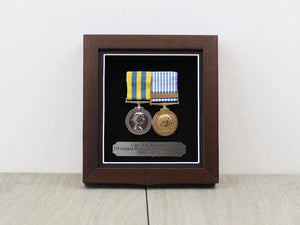
A clear layout usually places the medal group at the centre, with supporting objects arranged to read naturally. A portrait may sit above or beside the group. A concise engraved plaque can record the recipient's name, rank, regiment or service and dates. Where records are available, a carefully reproduced extract is preferable to placing irreplaceable original documents in prolonged light.
Background colour requires judgement. Black, deep blue, bottle green and regimental tones can work well, but a dark ground may hide dark ribbons or bronze medals. Neutral grey, cream or a muted service colour can make individual details easier to see. Avoid patterned fabric or highly decorative borders unless they are genuinely relevant to the recipient's service. The medals should remain the focus.
There is also a balance between symmetry and accuracy. A set of five medals may naturally sit in a straight row, while a memorial display containing a medal pair, photographs and badges may need an asymmetrical arrangement. The arrangement should feel ordered, but it does not need to resemble a shop display. A family keepsake can be personal without becoming cluttered.
Framing will not correct tarnish, damaged ribbons, loose suspensions or incorrect mounting. Deal with those issues first. Gentle specialist cleaning can improve presentation, but over-cleaning is a real risk. Original patina often forms part of a medal's age and character, particularly with older campaign and commemorative issues. Abrasive polishing can soften detail, damage plating and diminish collector interest.
Ribbons may be faded, frayed or stained through ordinary wear. Replacement ribbons can restore the visual integrity of a display, provided they are correct for the medal and the original material is retained with the group where possible. For a historically significant group, it may be preferable to preserve the original ribbon and document its condition rather than replace it without record.
Empire Medals can assist with specialist medal mounting, cleaning, engraving and bespoke framing, allowing the condition and presentation of a group to be considered together rather than as separate jobs.
Before committing medals to a frame, establish how they will be secured and whether they can be removed in future without damage. Ask whether acid-free, conservation-suitable materials are used; whether the frame includes UV protection; and whether the proposed layout has been checked against the correct order of wear.
It is also sensible to ask for dimensions and a visual plan before work begins, particularly for a large group or a display incorporating photographs and insignia. Confirm whether the original medals, documents and badges will be photographed or inventoried on receipt. Clear handling procedures matter when objects are valuable, named or impossible to replace.
Finally, consider where the frame will live. Keep it away from direct sun, radiators, fireplaces, kitchens and persistently damp walls. Even a well-made case cannot compensate for a poor environment. Periodically check for condensation, insect activity, fading or signs that a fitting has loosened.
A well-framed medal group should look considered rather than overworked. More importantly, it should leave the honours, the service behind them and the family's connection to them intact for the next person who pauses to look closely.
Leave a comment