
Expert Support
Visit our Helpdesk
Visit our Helpdesk

A medal’s ribbon can fade long before its metal shows distress, particularly when it has spent years near a sunny window or in a damp loft. The best ways to store medals protect both elements: the decoration, its suspension ribbon, and the history attached to them. Whether you hold a single family campaign medal or a mounted group worn on parade, good storage should prevent handling damage while keeping the awards accessible and correctly presented.
Before choosing a box, cabinet or frame, establish what you are storing. Original issued medals, unnamed campaign awards, professionally mounted groups, miniature sets and MoD Licensed Replica Medals do not all need the same treatment. An original group with its original ribbons and box is an historic object. It should be handled as little as possible and stored with its provenance, such as entitlement documents, photographs and service papers, kept separately but clearly associated.
Decide, too, whether the medals are to be preserved, displayed, worn, or passed on. A veteran’s current court-mounted medals may need a protective case that permits regular parade use. A relative’s First World War pair may be better kept in stable, dark storage, with a high-quality framed reproduction or photograph used for display. There is no single perfect solution; the right choice depends on the medals’ condition, material and intended use.
Record each medal before putting it away. Take clear photographs of the obverse, reverse, naming and any clasps. Note the ribbon order and mounting style of a group. This provides a useful reference for insurance, future research and correct remounting should a ribbon or fixing require attention.
For medals not on display, a purpose-made medal storage case or archival-quality box is usually the most dependable option. It protects against dust, light and accidental knocks without creating the pressure that can crease ribbons or rub high points of the metal. Choose a case with a supportive, inert lining and sufficient depth for the medals to lie naturally. Avoid forcing a mounted group into a shallow compartment.
Do not assume that any attractive presentation box is safe for long-term storage. Some older boxes contain acidic card, adhesives, foam or timber finishes that can affect metal and fabric over time. Certain plastics can release vapours that encourage tarnishing, while ordinary foam may break down and adhere to ribbons. If a box has a strong chemical smell, sheds particles, or leaves a greasy residue, it is not a suitable permanent home.
A dry cupboard in a lived-in part of the house is generally preferable to a garage, shed, loft or cellar. These spaces often have greater swings in temperature and humidity. Damp encourages corrosion and mould; excessive heat and direct sun can bleach ribbon colours, dry leather fittings and degrade paper records. Store medals away from radiators, exterior walls and windows, and never in a bathroom or kitchen where moisture levels rise frequently.
If you use a drawer, dedicate a clean section to the collection. Medals should not be loose among jewellery, keys, loose change or tools. Each item can be separated with acid-free tissue or placed in an individual archival sleeve, provided it is not tightly sealed against a damp surface. For groups, support the full width of the mounting so that pins, brooches and ribbons are not bearing unnecessary strain.
The aim is a stable domestic environment, rather than extreme dryness. A small amount of silica gel in a storage case can help in a known damp location, but it must be monitored and renewed or regenerated according to its instructions. It is not a substitute for moving the medals to a more suitable room.
Avoid wrapping medals in cling film, sealing them in ordinary plastic bags, or coating them with household polishes. These methods can trap moisture, leave residues and make later conservation more difficult. Tarnish is not always damage: on older silver medals, a natural, even patina may be part of the object’s age and character.
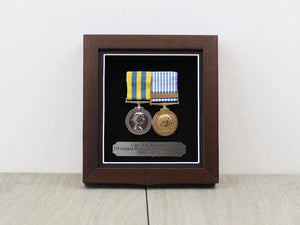
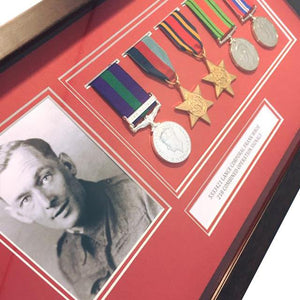
Framing is one of the best ways to store medals when display matters as much as protection. A properly constructed medal frame keeps a group secure, presents it in the correct order and reduces routine handling. It can also accommodate a cap badge, photograph, service details or a discreet engraved plaque, turning a medal group into a lasting family record.
The quality of the materials matters. A suitable frame should use an acid-free mount and backing, secure but non-damaging fixings, and glazing that helps reduce ultraviolet exposure. Conservation-grade or UV-filtering glazing is especially worthwhile for bright rooms, although no framed textile should be displayed in direct sunlight. Position the frame on an internal wall where possible, away from fireplaces, radiators and persistent damp.
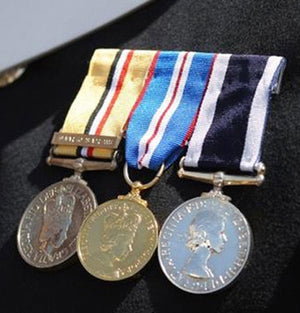
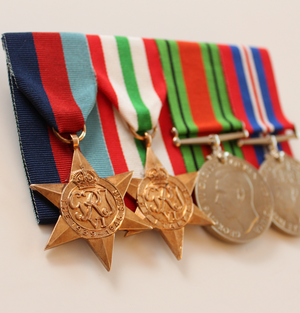
Do not glue medals or ribbons directly to a backing board. Adhesives may stain the ribbon, react with metal, or make proper conservation impossible. A specialist should mount the medals in the correct order and style, whether court mounted or swing mounted, while preserving a respectful ceremonial appearance. This is particularly important for groups that may later be worn for commemorative events.
For original family medals, consider whether permanent display is really necessary. A professional frame can be appropriate, but an archival storage case may be the safer option for fragile ribbons, paper labels or medals showing active corrosion. A display-quality copy, photograph or researched service record can often tell the story without exposing the originals to years of light.
Mounted groups should be stored flat where possible, with no weight placed on the ribbons or fittings. Hanging a group by its brooch for years can pull on the suspension bar and distort the backing. If it must be kept upright in a case, make sure the whole group is supported rather than dangling from one point.
Ribbons need particular care. Their colours are vulnerable to light, and their woven fibres can suffer from folds, abrasion and damp. Never iron a medal ribbon or attempt to remove a crease with steam. If ribbons are frayed, faded or incorrectly fitted, specialist remounting is usually safer than an improvised repair. Replacement ribbon can restore the formal appearance of a wearable group, while original ribbon may be retained separately as part of the medal’s history.
Before storing medals after a parade or commemorative occasion, allow them to air briefly in a clean, dry room. Wipe away fingerprints from polished modern medals with a soft, clean microfibre cloth, using very light pressure. Do not use silver dip, abrasive polish, metal wadding or household cleaning products on historic awards. These can remove detail, harm lacquered surfaces and produce an unnaturally bright finish.
Clean hands are essential. Cotton gloves can be useful for delicate ribbons and highly polished surfaces, but they can reduce grip and increase the risk of dropping a medal. For most handling, clean, dry hands and a careful hold around the edge or suspension are more practical. Work over a clear table with a soft towel beneath the medals, not over a hard floor.
If you see green deposits, powdery corrosion, sticky residue, mould, loose ribbon threads or a damaged suspension ring, stop cleaning. These are cases for a specialist assessment. The same applies to medals with original naming, gilt finishes, enamel, painted details or unusually dark surfaces. Preservation is not about making every medal look new; it is about preventing further loss while respecting authentic condition.
Empire Medals can assist with specialist medal cleaning, stay-bright coating, mounting and bespoke framing where a group needs professional attention. For valuable original awards, ask about the proposed work before proceeding and make clear whether the medals are intended for wear, display or long-term preservation.
The paperwork around a medal can be as valuable to a family as the medal itself. Keep copies of service records, citations, photographs, entitlement evidence and purchase details in an acid-free folder or archival sleeve. Label the folder with the recipient’s name, service number, regiment or service branch, and the medal group it relates to.
Avoid keeping paper directly beneath medals in a closed case. Paper can transfer acids and inks, while metal can mark or tear documents. A simple system works well: medals in their protective case, documentation in a separate labelled folder, and a written note explaining where both are kept. This makes a significant difference when medals pass to the next generation.
A well-stored medal group should feel cared for, not hidden away. Give it a stable environment, the right support and a clear record of its story. That is the practical foundation for preserving honours with the respect they deserve.
Leave a comment