
Expert Support
Visit our Helpdesk
Visit our Helpdesk

A die-struck medal should look and feel like an award made to endure. For veterans replacing lost medals, families preserving a relative’s service history, or collectors completing a period-correct group, knowing how to order die-struck medals helps avoid costly inaccuracies in the medal itself, its ribbon, clasps and presentation.
Die-striking produces a sharply defined design by pressing metal between engraved dies under considerable pressure. It is the traditional method associated with quality British medal manufacture, giving raised details, crisp lettering and a satisfying weight. The ordering process is straightforward when the service, entitlement and intended use have been identified properly at the outset.
The first task is to establish exactly which medal is required. A campaign, service or commemorative medal may have a similar appearance to another award from the same period, but a small difference in date, ribbon or reverse inscription can matter greatly. Do not rely on memory alone where records, photographs or original paperwork are available.
For a replacement or family commission, begin with the recipient’s service number, rank, regiment, corps, branch or unit, and the relevant dates of service. A service record, discharge document, medal card, citation or photograph showing ribbon bars can provide useful confirmation. For later awards, official notifications and deployment dates may also help establish entitlement.
It is worth distinguishing between an official issue and a high-quality replica. Officially issued medals are obtained through the appropriate government channels where an entitlement is being claimed. MoD licensed replica medals are intended for replacement, display, collecting and ceremonial purposes where appropriate. They should never be represented as original issued awards or used to make a false claim of service.
If there is uncertainty, pause before placing an order. A specialist supplier can often help identify the likely medal from the available details, but accurate information from the customer remains the best foundation for a correct result.
Once the award has been identified, decide how it will be worn or displayed. Full-size medals are normally chosen for parade wear, formal occasions and framed presentation. Miniature medals are intended for mess dress, evening dress and other formal wear where miniature groups are prescribed. A miniature is not simply a smaller keepsake: it must use the correct miniature ribbon, suspender and proportion for the medal.
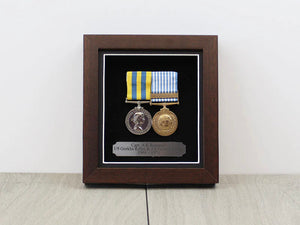
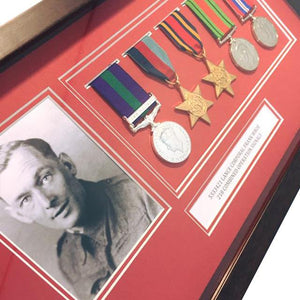
The choice also depends on the purpose. A single full-size die-struck medal may be appropriate for a replacement or a family display. A complete group may be needed when restoring a medal bar to its proper sequence. Collectors may prefer an individual medal in its own right, while a framed presentation often benefits from an accompanying nameplate, service details or a carefully selected photograph.
Check whether the medal should be supplied loose, with ribbon fitted, or prepared for mounting. Ordering a loose medal can be sensible if an existing group is being repaired. For a new group intended for wear, arranging professional mounting at the same time usually provides a more consistent result.
The ribbon is part of the award, not an optional finishing detail. Confirm its colours, stripe order and width against the medal concerned. A ribbon that is close in appearance but belongs to another campaign will undermine an otherwise accurate group.
Many British campaign medals also have clasps. These may show a theatre, operation, date range or qualifying period. A clasp should only be selected where the recipient was entitled to it. In some cases, a rosette worn on the ribbon denotes entitlement to a clasp when the ribbon alone is worn. The details vary by award, so this is another point where records are particularly valuable.
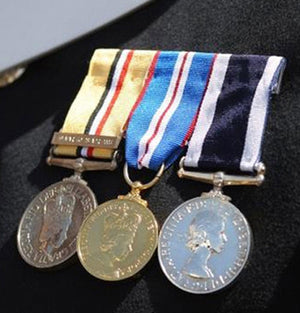
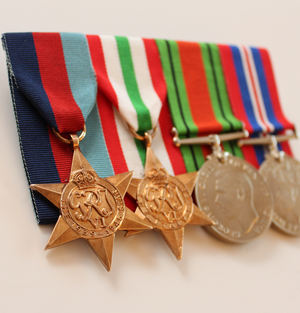
When ordering several medals, establish the correct order of wear before they are mounted. British orders of wear are governed by established precedence, and campaign medals, jubilee medals, long-service awards, NATO medals and United Nations medals do not simply follow the order in which they were received. This matters on parade and in a formal display alike.
Medal groups call for a little more preparation than a single award. Lay out the full group on paper first, using the medals, ribbons and clasps in their expected order. Include awards that are already held if they will remain part of the finished bar. This prevents a new medal being made up in isolation only to discover that it does not match the scale, ribbon length or mounting style of the others.
Before placing the order, have these details ready:
Where original medals form part of the group, consider their condition before mounting. Cleaning may improve the appearance of tarnished pieces, but excessive polishing can remove historic patina and soften detail. A careful, sympathetic approach is usually best for inherited awards. If the group includes replacement die-struck medals, a professional presentation service can help achieve a balanced finish without treating family heirlooms as if they were new items.
Naming is one of the areas where customers should be especially precise. Some original British medals were officially impressed or engraved with the recipient’s details, while others were issued unnamed. A replica or replacement can be engraved for identification or presentation, but the style should be considered carefully.
For a family keepsake, a clear inscription with name, rank, service number and relevant dates can add real value. For a historically styled replacement, the wording and character of the engraving should suit the medal and period as closely as possible. Avoid adding details that cannot be supported by service records, particularly on awards connected with a specific campaign or gallantry recognition.
Engraving is permanent, so check spelling, initials, rank abbreviations and service numbers before confirming the order. The same care applies to presentation plaques and framed displays. A well-made medal deserves accurate supporting information.
A die-struck medal may be produced in different base metals and finishes according to the design and intended standard. The key consideration is not simply whether a medal appears bright in a product image, but whether its detailing, weight, ribbon fitting and overall construction are appropriate for the award.
Look for British-made and die-struck workmanship where authenticity of appearance and long-term presentation matter. MoD licensing is also a meaningful assurance for replicas of applicable British military medals. It indicates that the design is produced under recognised authority rather than copied from an uncertain source.
For a medal that will be worn outdoors, ask how it should be cared for. Fingerprints, moisture and unsuitable polishing products can mark metal surfaces or affect ribbons. A stay-bright coating can be useful for medals worn regularly, though some collectors and families may prefer an untreated finish that can be maintained conventionally. The better option depends on whether the priority is low-maintenance parade wear or a more traditional collector’s presentation.
A final review is the simplest way to prevent errors. Read each medal title in full, check the size, ribbon, clasp and quantity, then confirm the order of wear and mounting method. If engraving is included, compare every character with the source document rather than relying on a typed note or memory.
Also consider the destination. A medal intended for a funeral tribute, regimental event or anniversary presentation may need mounting and delivery arranged well in advance. A framed family piece may require more time than a loose medal because the layout, captioning and finishing all need individual attention.
Empire Medals provides British-made die-struck medals alongside specialist mounting, engraving and display services, allowing a replacement or complete group to be prepared with the same attention to detail from medal selection through to presentation.
A properly ordered die-struck medal is more than a precise reproduction of an award. It is a respectful record of service, made ready to wear, preserve or pass on with confidence.
Leave a comment