
Expert Support
Visit our Helpdesk
Visit our Helpdesk

A campaign medal is more than a decorative object. It records service, qualification, courage or a moment in family history. When choosing between framed medals or a display case, the right answer depends on what you wish the presentation to do: tell a personal story, protect a growing collection, preserve original ribbons, or create a formal tribute for a home, mess or regimental setting.
Both options can provide dignified, secure presentation. The difference lies in access, scale and the way the medals are viewed. A carefully framed group creates a permanent record with strong visual impact. A display case offers flexibility, particularly where a collection may expand or where medals need to be examined from time to time.
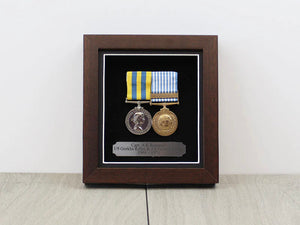
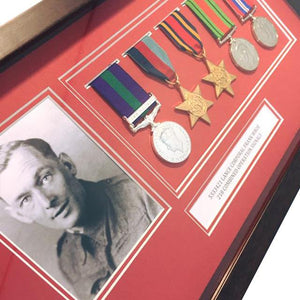
Framing usually suits a defined medal group. This may be a veteran's own entitlement, a relative's medals, or a complete historical group acquired by a collector. The medals are arranged against a chosen backing, often with a nameplate, service details, cap badge, photographs or copied documentation. Once professionally finished, the display becomes a complete narrative rather than simply a row of awards.
A display case is generally better suited to objects that need room around them. Alongside full-size or miniature medals, it can accommodate a beret badge, ribbon bar, identity tags, shoulder titles, photographs, citations or other associated pieces. It also works well for collectors who acquire medals over time and do not want each new addition to require a new frame.
There is no hierarchy between the two. Framing is not automatically more respectful, and a case is not necessarily less formal. The decision should follow the character of the medals and the purpose of the display.
A frame is particularly effective when the medals belong together and their story is complete. This is often the case with a deceased relative's group, a retirement presentation or a set mounted to the correct court or swing style for ceremonial wear before being preserved for display.
The compact format makes a framed group suitable for a hallway, study, office or living room, where wall space is available but cabinet space is limited. It also gives families a clear focal point for remembrance. A well-planned frame can place the medals at the centre while supporting material adds context without distracting from the awards themselves.
Professional framing matters because medals carry weight and ribbons can fade or distort if poorly supported. The arrangement should keep the group level, retain the correct order of wear and avoid adhesives or fixings that could mark original components. If medals have been mounted for wear, the framing should respect that workmanship rather than force the group into an unsuitable layout.
Less is often more. The most successful frames normally include the medal group, a concise engraved plate and one or two supporting items. A service photograph or copied citation can be highly effective, provided the display does not become overcrowded.
Where the medals are originals, consider displaying good-quality copies of fragile documents rather than the documents themselves. Original paperwork may be better retained in archival storage, away from light and changes in humidity. The same consideration applies to old photographs, which can be especially vulnerable to fading.
A display case is the practical choice for a larger collection, an evolving collection or objects with different depths and shapes. It provides room to arrange medals by campaign, service branch, period or recipient, while allowing viewers to appreciate details such as clasps, reverse inscriptions and ribbon variations.
For collectors, access is the principal advantage. A suitably designed case allows medals to be removed for research, cataloguing or comparison without dismantling a fixed presentation. That said, access should be balanced against security. The case needs a reliable closure and should be placed where it is protected from accidental knocks, curious children and direct sunlight.
Cases are also valuable where medals are displayed with related uniform items. A group from the Second World War, for example, may sit naturally beside a cap badge, ribbon bar, portrait and unit insignia. For more recent service, an operational medal group can be presented with a framed certificate or a small selection of approved insignia, provided every item is clearly associated with the recipient.
A display case should give every item enough space to be seen. Packing medals too tightly can obscure the ribbons, make the arrangement appear untidy and increase the chance of pieces rubbing together. Separate groups with clear visual boundaries, and use neutral backing materials that do not compete with the ribbon colours.
If the collection is substantial, several smaller cases can look more considered than one large, crowded cabinet. They also allow you to organise medals by era, campaign or family branch without implying a connection where none exists.
Whether medals are framed or housed in a case, light is the most common long-term concern. Ultraviolet exposure can fade ribbons, discolour paper and affect photographs. Choose a position away from direct daylight, radiators, fireplaces and damp external walls. A north-facing room or an interior wall often provides a more stable environment than a bright conservatory or window alcove.
Avoid attaching original medals to backing with glue, tape or staples. These methods may stain fabric, leave residue or make future conservation difficult. Original ribbons can be irreplaceable, even where replacement ribbons are readily available. Correctly sized mounts, discreet supports and professional fitting protect the medals while maintaining an orderly appearance.
Cleaning also requires restraint. Tarnish on a silver medal is not automatically damage, and aggressive polishing can remove surface detail or alter an original finish. Before framing a historic group, seek specialist advice on cleaning, stay-bright coating or conservation. Modern replacement and replica medals may suit a different approach from original named awards.
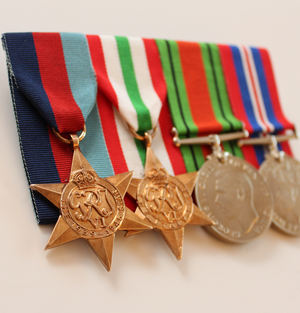
Medals should be arranged in the correct order of wear. This is essential for a service group and equally important for a replica or commemorative presentation. The order can vary according to the awards held, the date of issue and the recipient's service, so assumptions are risky.
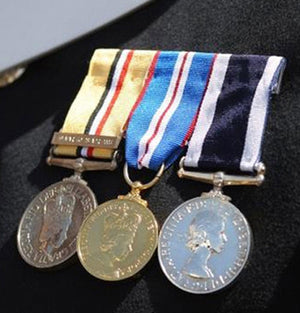
The choice between swing mounting and court mounting also affects the finished display. Swing-mounted medals retain their traditional movement and can be easier to inspect individually. Court mounting gives a neater, more compact ceremonial appearance and offers additional support, especially for longer groups. Neither is universally right. The correct option depends on the recipient's preference, the medals' intended use and established service practice.
For families replacing lost medals, make the distinction clear within the presentation. MoD Licensed Replica Medals and correctly engraved replacements can create an appropriate tribute, but they should not be represented as original issued awards. A precise label protects the historical record and gives future generations an honest account of what they are viewing.
A dark background is traditional and often suits British military ribbons, but it is not the only suitable choice. Navy, charcoal, deep green and burgundy can work well when selected to complement the medal group. The backing should be colourfast and of a quality appropriate for long-term display.
Frame moulding should support the character of the presentation. A simple timber or dark finished frame may suit a family group, while a more restrained contemporary style can be right for a modern service display. Highly ornate frames can overwhelm medals, particularly small groups or miniature sets.
For display cases, consider the depth required before selecting a layout. Court-mounted medals, badges and mounted miniatures all project differently. Allow sufficient clearance between the contents and the glazing, and ensure the backing is firm enough to hold pins or specialist supports without sagging.
The best choice is the one that protects the medals and makes their significance clear. Select a frame when the group tells one complete story and deserves a permanent place on the wall. Choose a display case when the collection needs room to grow, be studied or sit alongside related objects.
For a formal family tribute or a collector's bespoke arrangement, Empire Medals can help bring together accurate medals, professional mounting, engraving and presentation services. Take time to record the recipient's name, service number, regiment or branch, dates and family recollections before the display is completed. Those details may prove as valuable to the next generation as the medals themselves.
Leave a comment