
Expert Support
Visit our Helpdesk
Visit our Helpdesk

A family medal group often comes out of its case for one reason - remembrance. Whether it is a grandfather’s campaign medals, a father’s long service decoration, or a casualty group handed down through generations, the question is usually the same: who can wear inherited medals, and what is the correct way to do it?
In Britain, inherited medals may be worn by a direct descendant or close family member as a mark of remembrance, but there are conventions that matter. The distinction is not simply about permission. It is about respect, correct wear, and understanding when family commemoration differs from the original recipient’s entitlement.
The accepted British custom is that family members may wear inherited medals in remembrance of the person who earned them. Most commonly, this means a son, daughter, grandson, granddaughter, widow, widower or another direct descendant. In practical terms, people usually wear them at memorial services, funerals, Armistice events, Remembrance Sunday parades and similar occasions where family tribute is appropriate.
There is, however, a difference between what is socially accepted and what is formally awarded. The recipient alone was awarded the medal for service or gallantry. An heir does not inherit that entitlement in the official sense. What they inherit is the responsibility to preserve and present those medals properly.
That is why etiquette matters so much. A family member can wear inherited medals as a tribute, but should never present them as decorations personally earned.
This is the point that causes most confusion. Medals earned by the wearer are worn on the left breast. Inherited medals worn in remembrance are worn on the right breast.
That convention makes the meaning immediately clear. Left side denotes personal service and award. Right side denotes family remembrance.
If someone asks who can wear inherited medals, the fuller answer is not only who, but how. Even where it is entirely proper for a relative to wear them, placing them on the wrong side can give the wrong impression. For formal commemorative occasions, especially where veterans, serving personnel and standards are present, that distinction should be observed carefully.
In most cases, yes, at least in terms of propriety. A close family link is the clearest basis for remembrance wear. Children and grandchildren are the most common wearers, followed by spouses and occasionally nephews, nieces or other relatives where there is no closer surviving line.
There is no single statute that lists every permitted relationship for all occasions, and practice can vary by organisation or event. Some veterans’ associations and parade organisers take a practical, respectful view. Others may prefer direct descendants only. If the medals are being worn at a specific organised event, it is sensible to check expectations in advance.
The guiding principle is straightforward. The nearer the family connection, the more widely accepted the wear will be. Where the connection is more distant, discretion is wise.
Not at the same time if using the original group, for obvious reasons. But across different events, different family members may wear them in remembrance. In some families, one person becomes the custodian of the medals while others choose to wear replica sets for major commemorations.
That is often the best solution when the originals are valuable, fragile or of considerable sentimental importance. A properly made replica set allows the family to maintain the correct order of wear and presentation without risking loss or damage to the original medals.
For older groups, especially First and Second World War medals, ribbon wear, edge knocks, brooch wear and naming detail all deserve protection. If a medal group is irreplaceable, wearing replicas and preserving the originals for display can be the more responsible choice.
In general, yes. It is common in the UK to see relatives wearing inherited medals on the right side at Remembrance Sunday services, Armistice commemorations, regimental events and funerals. This is well understood by the public and by many within the armed forces community.
That said, context matters. A local remembrance service may be relaxed and family-focused. A formal military parade may have tighter expectations about dress, protocol and appearance. If you are attending in civilian dress, remembrance wear is usually straightforward. If you are also wearing a uniform of any kind, including cadet or ceremonial dress connected to an organisation, different rules may apply.
Where there is any doubt, it is better to ask the organiser than to assume.
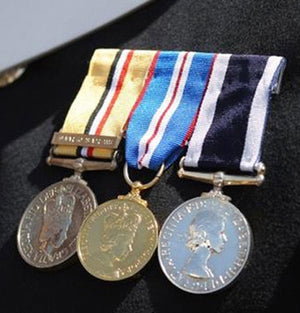
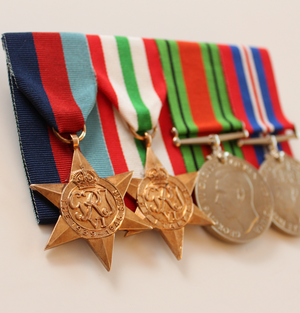
If the medals are to be worn regularly, proper mounting is advisable. Loose medals can swing, clash and suffer ribbon damage. Correct mounting also ensures the group hangs neatly and reflects the dignity of the occasion.
Court mounting is widely preferred for modern wear because it provides a smart, stable finish. Swing mounting may be appropriate for certain historic styles or personal preference, but neatness and correctness are the main considerations. The order of wear must also be exact, particularly where campaign medals, coronation medals, efficiency decorations and foreign awards appear together.
This is where specialist support matters. A medal group that has been badly re-ribboned, mounted in the wrong order or fitted with poor quality brooches can look incorrect immediately to anyone familiar with British medal traditions. For inherited groups, presentation should be as respectful as preservation.
Miniatures follow the same broad etiquette. If worn in remembrance, they should be worn on the right side. They are often used for evening functions, mess dress contexts where appropriate, or by those who want a lighter and more practical set for commemorative occasions.
Again, the key point is not size but status. They are still medals not personally awarded to the wearer, so the side of wear remains the important distinction.
Generally, that is not considered appropriate unless there is a very clear and respectful reason, such as acting in a formal commemorative role with the family’s blessing. Even then, it is uncommon.
Collectors, historians and reenactors may own original medals, but ownership is not the same as family connection. Buying a medal group does not create a right to wear it in personal remembrance. In the British context, medals carry a strong association with service, sacrifice and kinship. That is why inherited wear is accepted as a family tribute, not as a matter of possession.
Before they are worn, they should be checked carefully. Old ribbons can become brittle, brooch fittings can weaken, and naming can be dulled by poor storage or over-cleaning. Medals should never be aggressively polished, and any restoration needs to be handled with restraint. Patina is often part of the medal’s history.
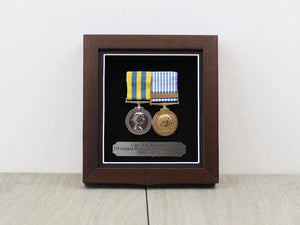
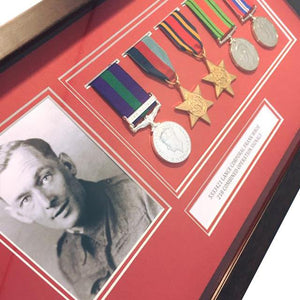
Storage matters just as much. Keep medals dry, away from direct sunlight, and supported so the ribbons do not crease or pull. If they are not being worn often, a framed display or fitted case may be the safer option. For many families, this balance between preservation and ceremonial use is the right one.
Where practical wear is still important, many families now keep the originals safely displayed and use high-quality replicas for parades and memorial dates. For valuable or vulnerable groups, that approach protects both heritage and appearance.
The most frequent mistake is wearing inherited medals on the left side. The second is assuming any relative, however distant, can wear them without question. The third is using poor quality copies or incorrect ribbon combinations that misrepresent the original entitlement.
Another mistake is treating medals as costume items rather than honours. British medals are not decorative accessories. Even where remembrance wear is accepted, the standard should be careful and restrained.
If a family is uncertain about naming, entitlement, ribbon order or whether a group should be restored or left untouched, specialist advice is worth seeking before any work is carried out. Accuracy is part of respect.
So, who can wear inherited medals? In British practice, close family members may wear them in remembrance, normally on the right breast, and most often for funerals, memorial services and Remembrance events. They should not be worn as though personally earned, and they should be mounted and presented correctly.
For some families, the best answer is to wear the originals carefully and only on significant occasions. For others, especially where medals are rare, named, or in delicate condition, replica sets are the better working option while the originals are preserved. That balance between ceremony and safeguarding is often the mark of proper custodianship.
If you are wearing a relative’s medals, you are not borrowing their service. You are carrying their memory, and that deserves to be done properly.
Leave a comment