
Expert Support
Visit our Helpdesk
Visit our Helpdesk

A NATO Medal is not awarded simply because someone served in the Armed Forces during a NATO operation. NATO medals eligibility depends on the specific mission, the dates and location of service, the individual’s role, and whether that service met the qualifying criteria set for the operation. For veterans and families seeking a replacement or replica, establishing entitlement first protects the accuracy and significance of the medal group.
The NATO Medal recognises service connected with NATO-led operations and missions. It may be awarded to members of the armed forces of NATO nations, partner nations and, in certain circumstances, civilian personnel who served under NATO command, control or support arrangements.
The key point is that eligibility is operation-specific. Each mission has its own qualifying period, geographical area, commencement date and rules on the type of service accepted. A tour in the wider region of an operation does not automatically qualify. Equally, a person may qualify without having served in the most obvious location if their formally tasked role met the direct-support criteria.
For UK personnel, entitlement is normally considered through the chain of command or the relevant service records process. The final authority rests with the official awarding body, not with a medal retailer, unit association or family member. This distinction matters when ordering a replacement, replica or court-mounted group.
Many NATO Medal awards have used a qualifying period of 30 days' service, whether continuous or accumulated, in the designated operational area. That is a useful starting point, but it is not a universal rule. Criteria can differ between missions, and exceptional circumstances such as evacuation, injury, death, or operational duties outside the normal area can affect an individual case.
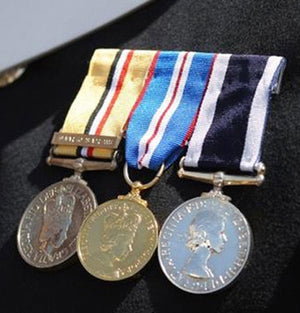
NATO operations have included missions in the former Yugoslavia, Kosovo, Afghanistan, Libya and the Mediterranean, along with a range of later support and training commitments. The medal may carry a clasp identifying the operation, or it may be issued under a particular NATO medal category. The ribbon and clasp are therefore as important as the medal itself when identifying a correct entitlement.
A veteran who served in Afghanistan, for example, may have received both British campaign recognition and a NATO Medal, provided the separate conditions for each award were met. One award does not automatically prove entitlement to the other. British and NATO awards were created under different authorities and may use different qualifying dates or service definitions.
The phrase "under NATO command or control" is central to many cases. Personnel attached to a NATO headquarters, deployed with a NATO force, or assigned to an authorised NATO task may be eligible where their service falls within the published criteria.
Direct support can be more difficult to assess. A role may have supported an operation in a practical sense without meeting the formal definition required for the medal. Logistics, intelligence, aviation, medical and communications personnel may qualify, but only where their tasking, location and period of service satisfy the rules for that mission.
This is why recollection alone is not always enough when reconstructing a medal entitlement years later. Operational orders, posting records, tour reports, certificates and service documentation can all help establish the precise nature of service. For families researching a relative's group, these records are often more reliable than photographs, especially where a clasp is not visible.
Some NATO Medal criteria extend beyond uniformed service personnel. Eligible civilians may include staff working for NATO, national civilian employees, contractors in defined roles, or personnel from partner organisations. However, eligibility for civilian staff is usually tightly controlled and should never be assumed from workplace location alone.
Personnel from non-NATO countries can also receive the medal when serving with an authorised NATO force or mission. The principle remains the same: the individual must fall within the eligibility instructions for that operation.
NATO medals can be confusing because the same broad medal design may represent very different operations. The identifying detail is frequently the clasp. Examples include clasps associated with former Yugoslavia, Kosovo, Article 5 operations, non-Article 5 operations, ISAF, Libya and later missions.
Where an individual has qualifying service for more than one NATO operation, the method of recognition depends on the relevant award regulations. It may involve an additional clasp, a numeral or another authorised distinction rather than a second full-size medal. Wearing two apparently identical NATO Medals where only one is authorised can make an otherwise accurate group incorrect.
There are also distinctions between NATO medals and other international awards. A United Nations Medal, an Operational Service Medal, a General Service Medal and a NATO Medal may relate to the same broad period of service, but they are separate awards with different ribbons, authorities and rules. A careful check prevents accidental substitution when replacing missing medals.
The strongest evidence is an original award certificate, often referred to as a medal certificate, together with service records showing the relevant deployment. A discharge book, Certificate of Service, photographs and veteran recollections can provide valuable supporting detail, but they may not settle every question.
For serving personnel, the first route is normally the unit administration office or chain of command. Veterans should consult the appropriate service records or medals office process for their branch of service. Next of kin researching a deceased relative should gather as much documentary evidence as possible before requesting a formal view.
When checking a possible entitlement, record the operation name, dates of arrival and departure, location, unit or appointment, command relationship and any clasp shown on existing paperwork. These details make it far easier to distinguish between similar-looking awards and ensure a replica is specified correctly.
It is sensible to retain copies of certificates and deployment evidence with the medal group. Medals often become family heirlooms, and a clear record can spare later generations considerable uncertainty.
An officially issued medal and a replica serve different purposes. Official replacement procedures are the proper route where an entitled recipient needs a replacement issued through the relevant authority. A high-quality replica is commonly chosen for everyday ceremonial wear, display, a restored group, or where an original has been lost and an official replacement is not available.
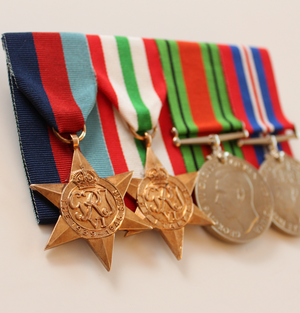
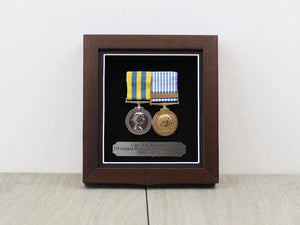
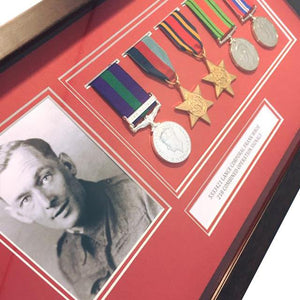
For display or parade wear, accuracy means matching the correct full-size or miniature medal, ribbon, clasp and naming details where applicable. Medal mounting should also reflect the recipient's authorised group and the appropriate style of wear. Court mounting offers a neat, secure finish for ceremonial use, while loose medals may be preferred for a collection or framed family display.
Empire Medals supplies specialist replica medals and presentation services for customers who need a carefully specified group, including British-made and die-struck options where appropriate. A clear entitlement record helps ensure that every element, from ribbon to clasp, is selected with proper regard for service history.
A NATO Medal may be worn only when it has been officially awarded and accepted for wear under the applicable UK regulations. The correct position in a medal group depends on the current authorised Order of Wear and on the other awards held by the recipient. This is particularly relevant where a group includes British campaign medals, United Nations medals or foreign decorations.
Do not rely solely on the date a medal was received, or on the arrangement shown in an old photograph. Regulations, recognition arrangements and the composition of a group can all affect mounting order. For a parade-ready group, it is worth checking the official entitlement and order before medals are mounted permanently.
A NATO Medal represents a defined contribution to a particular operation, not a general souvenir of military service. Before replacing, mounting or framing one, take time to confirm the mission, dates and clasp. That small act of care preserves both the medal's accuracy and the service it was awarded to recognise.
Leave a comment