
Expert Support
Visit our Helpdesk
Visit our Helpdesk

A medal is not an accessory on Remembrance Day. It represents service, sacrifice, family history or a connection to those being remembered. Good remembrance day medal etiquette is therefore less about display and more about wearing awards accurately, securely and with proper respect.
For veterans, serving personnel and families attending a parade, church service or local act of remembrance, a few established conventions prevent uncertainty. The central rule is straightforward: wear your own medals on the left breast. Medals belonging to a relative may be worn on the right breast by a close family member.
Medals awarded to you are worn on the left breast. This applies whether you are in uniform or wearing civilian dress, such as a suit, blazer or smart coat. On Remembrance Sunday, full-size medals are the usual choice for daytime commemorative events.
A relative's medals should not be worn on the left, as this can suggest that the wearer received the award. Where a family chooses to wear medals in remembrance of a deceased relative, they are conventionally placed on the right breast. This is commonly seen among widows, widowers, children and grandchildren at remembrance services.
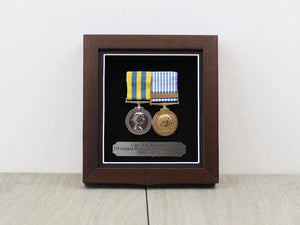
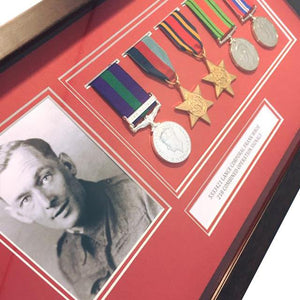
There is no need to wear a relative's medals if you would rather carry them, keep them framed or display them at home. These choices can be especially appropriate for original groups that are fragile, valuable or of significant family importance. The act of remembrance matters more than whether medals are worn.
Medals are worn over the left breast, in a position that is high enough to be clearly above the jacket pocket but not close to the collarbone. They should lie flat and remain stable when standing, sitting and moving. A loose ribbon bar, twisted suspender or medals that knock together can look untidy and may cause unnecessary wear.
Relative's medals sit in the corresponding position on the right breast. They should be mounted in the same careful manner as personal awards. Pinning loose medals directly through a jacket may be acceptable for a single item in an informal setting, but a properly mounted group is safer, more comfortable and more dignified for a parade or service.
Do not attach a poppy through a medal ribbon. If you are wearing a poppy and medals together, position the poppy so that it does not cover the ribbons or interfere with the medals. Event organisers, branches and serving units may offer local guidance, particularly where uniform is worn, and that guidance should take precedence.
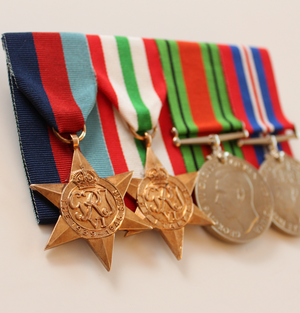
If you have more than one award, they must be arranged in the official order of wear. This is not simply chronological, nor should medals be rearranged according to personal preference. British campaign medals, decorations, commemorative medals and overseas awards each have an established place in the sequence.
The order can become complicated where a group includes gallantry awards, campaign medals, long service and good conduct medals, Coronation or Jubilee medals, United Nations or NATO medals, and foreign awards. A mounted group should preserve the authorised sequence, with ribbons showing correctly and clasps positioned securely.
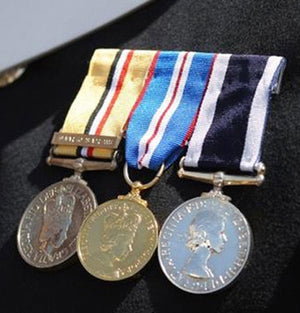
When medals are court mounted, the ribbons are fixed to a backing and the lower portion of each medal is secured. This is the familiar formal presentation seen at ceremonial occasions. Court mounting keeps a group neat and reduces movement, making it particularly suitable for Remembrance Sunday, parades and official commemorations.
Swing mounting leaves medals hanging independently from the ribbon bar. It remains a recognised traditional style and is often preferred where the original character of a group is to be retained. The right option depends on service convention, personal preference and the condition of the medals. For a parade-ready finish, the important point is that the group is correctly ordered, clean and firmly mounted.
Full-size medals are normally worn for Remembrance Day services and daytime parades. Miniature medals are generally associated with evening dress and formal dining occasions, rather than outdoor acts of remembrance.
Ribbon bars are primarily worn with certain forms of uniform when full medals are not ordered. They are not a substitute for medals on civilian dress at a Remembrance Sunday parade. Serving personnel should always follow the dress regulations of their Service, unit and occasion, as these may specify the authorised form of medals, ribbons and headwear.
Many families are rightly cautious about wearing original medals, particularly where a group is irreplaceable or includes a named gallantry award. A high-quality replica can provide a practical alternative for parades, travel and wet weather, while the originals remain safely stored or framed.
A replica should match the correct issue, ribbon and clasp entitlement. MoD Licensed Replica Medals are made for this purpose and offer a respectful way to represent a service record where originals have been lost, retained by another family member or are unsuitable for regular wear. Replicas should never be used to falsely claim service or entitlement.
Before ordering a replacement, check the exact medal name, relevant campaign dates and any clasps. Small differences matter. The General Service Medal, Naval General Service Medal and their later equivalents, for example, may have very different ribbons, busts and clasp combinations. A photograph of the original group, service papers or a medal card can help establish what is required.
Allow time before the event rather than taking medals from a drawer on the morning of the parade. Check each ribbon for fraying, staining or fading, and inspect the mounting bar, pins and catches. A damaged pin can pull through fabric or leave a medal group insecure at the worst possible moment.
Light dust can be removed with a soft, dry cloth. Avoid aggressive polishing, household metal cleaners and abrasive products, especially on original medals. Patina, named edges and original lacquer can be damaged surprisingly easily. Different metals and finishes require different treatment, so a specialist cleaning service is often the safest choice for older awards.
If a group has become tangled, has missing ribbons, loose clasps or damaged suspensions, have it repaired before it is worn. Re-ribboning and professional mounting can restore a coherent presentation without altering the historical integrity of the medals themselves. Empire Medals can assist with specialist medal mounting, cleaning and presentation work where a group needs careful preparation.
Medals show best against a smart, dark jacket or coat with a firm lapel. Ensure there is enough space for the group to sit naturally. A thin or loosely woven garment may not support several full-size medals well, while a very bulky coat can make them sit at an awkward angle.
Wear medals only for the period appropriate to the occasion. Put them on before the service or parade begins and remove them carefully afterwards. Avoid leaving medals loose in a pocket, handbag or car, where ribbons can crease and edges can rub together. A lined medal case, drawer tray or framed display is a much better long-term home.
If rain is expected, replicas may be the sensible choice. Water can mark ribbons and encourage tarnishing on certain metals, while repeated damp conditions can affect old mounting materials. Practical care is not a lack of respect for original medals. It is often the best way to preserve them for the next generation.
There will always be individual circumstances: a newly discovered family group, an overseas award, a veteran attending in civilian clothes, or medals shared between relatives. When in doubt, keep to the core convention of left for your own awards and right for family medals, then seek specialist advice on ordering and mounting.
A properly prepared medal group does more than complete ceremonial dress. It gives service history its rightful place in the day, allowing the wearer to stand with confidence while the medals themselves are treated with the care they deserve.
Leave a comment