
Expert Support
Visit our Helpdesk
Visit our Helpdesk

A medal group is not simply a row of decorations. It records service, campaigns, long commitment and, often, a family story that deserves to be handled correctly. Whether replacing lost awards for parade wear, preparing miniatures for mess dress, or preserving a relative’s entitlement, British army medal sets need to be accurate in composition, order and finish.
For serving personnel, veterans and families alike, the right set begins with the entitlement rather than the appearance. A beautifully mounted group can still be wrong if a clasp is missing, a campaign medal is included in error, or the medals are placed in the incorrect order of wear.
The most reliable foundation for any set is the recipient’s service record and official medal documentation. These establish which awards were issued or authorised, the relevant dates of service, and whether any clasps or emblems apply. This matters particularly with operational service, where qualification may depend on a specific location, period or number of days served.
Do not assume that every deployment produced a medal, or that a medal automatically carries a clasp. The General Service Medal, Operational Service Medal and campaign awards each have their own qualifying criteria. A rosette on a ribbon, an oak leaf emblem, or a numbered clasp can be as significant as the medal itself.
For family groups, photographs are useful supporting evidence, but they should not be the only source. Images can be reversed, obscured or taken before later awards were received. If records are incomplete, it is better to establish what can be confirmed and leave an uncertain space than to build a speculative group.
The choice depends on purpose. Original named medals have historic and collecting value, but they may be scarce, expensive or unsuitable for regular wear. A family may reasonably decide that an original group belongs safely framed at home while a replica set is worn at a remembrance service or regimental event.
For replacement and ceremonial purposes, MoD Licensed Replica Medals offer the appropriate balance of accuracy and practicality. British-made, die-struck replicas reproduce the weight, detail and formal appearance expected of a proper medal set. They should not be represented as original issued awards, but they are made for respectful, correct wear where an original is lost, fragile or retained for preservation.
Collectors have a different consideration. Replacing a missing medal within an original group can affect provenance and value, so the replacement should be clearly identified in accompanying documentation. A well-made replica can complete a display, but transparency protects both the history of the group and future collectors.
Full-size medals are the standard choice for ceremonial wear with service dress, formal civilian occasions and veteran parade attire. They are designed to be read at a distance and carry the visual presence associated with remembrance parades, investiture-related events and regimental gatherings.
Miniatures are normally worn with mess dress and on other evening dress occasions where regulations permit them. They are not merely smaller souvenirs. A miniature group should match the full-size entitlement precisely, including the correct ribbon, clasp and authorised emblem. The scale changes; the entitlement does not.
It is common for someone to need both versions. A full-size court-mounted set may be used for daytime ceremonial dress, while a miniature court-mounted group is prepared for dining-in nights or formal dinners. Ordering them together helps ensure that the sequence and details are consistent.
The medal ribbons also matter. Fading, incorrect shades and poor-quality weaving can make an otherwise accurate group look unconvincing. Ribbon bars, ribbon-only displays and medal ribbons for civilian clothes should likewise reflect the authorised order of wear.
British awards are worn in a prescribed order, broadly based on the nature and seniority of the award. Orders, decorations, campaign medals, long service and good conduct awards, jubilee medals and foreign awards do not simply follow the date on which they were received.
The position of an award can be affected by its category, while foreign medals have particular rules governing acceptance and wear. Commemorative medals not recognised for official wear must not be mixed into an official mounted group. This is one of the most common errors seen in inherited or self-assembled displays.
Where there is any uncertainty, the set should be checked against the current authorised order of wear and the individual’s entitlement. Regulations and administrative guidance can change, particularly concerning recently authorised awards. Accuracy is not about needless formality; it is a mark of respect for the service represented by the medals.
Small details can change a group substantially. Clasps identify a particular theatre or operation. An oak leaf emblem may denote a Mention in Despatches or King’s Commendation, depending on the award and period. Rosettes are used on ribbon bars to show an entitlement that cannot be fully represented by ribbon alone.
These features need correct placement and proportion. A clasp should be fitted to the relevant medal, not treated as an optional decorative addition. Equally, multiple clasps must follow the established sequence. Close inspection of service documentation is worthwhile before a set reaches the mounting stage.
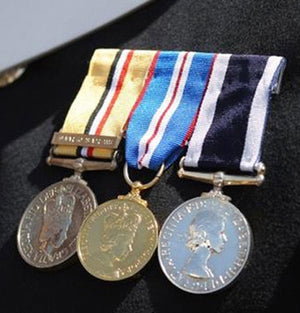
The two traditional methods serve different needs. Swing mounting leaves each medal suspended from its ribbon and allows the medals to move. It is the classic presentation and remains appropriate for many groups, particularly where a traditional appearance is preferred.
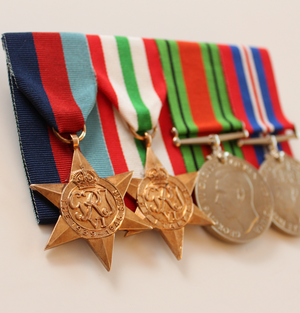
Court mounting fixes the medals to a rigid backing, usually with the ribbons arranged neatly behind them. It gives a flatter, more controlled line and is often favoured for parade wear because medals do not clash together as the wearer moves. It can also be more practical where several medals, clasps or emblems make a swing-mounted group heavy or uneven.
Neither method is universally right. The recipient’s service dress requirements, the number of medals, the condition of the originals and personal preference all count. A single or two-medal group may suit swing mounting very well. Larger sets often benefit from the tidy profile and stability of court mounting.
Professional mounting is particularly valuable when dealing with inherited originals. Ribbons may need replacing, suspension bars may be worn, and old stitching or adhesive can cause damage if handled carelessly. Specialist work should preserve the medals’ integrity while giving the group the secure, correct finish required for wear or display.
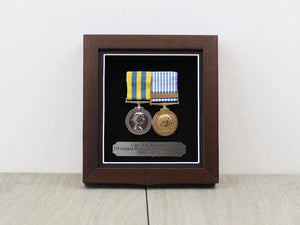
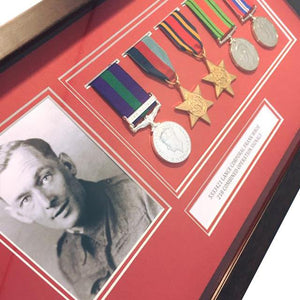
A medal set does not have to be worn to deserve proper finishing. Framing can protect a group from dust, handling and light while allowing the story behind it to be recorded. A considered display may include the recipient’s name, regiment or corps, dates of service, photographs, cap badge, insignia or copied documents.
Light is the principal long-term risk to ribbons. Strong daylight can fade colours unevenly, especially on older silk or wool ribbons. Humidity, tarnish and household cleaning products can also harm metal surfaces. Medals should be kept dry, handled by their edges where possible, and never polished aggressively simply to create a brighter appearance.
Cleaning requires restraint. Removing accumulated dirt may be appropriate, but patina on an original medal can be part of its history. Before cleaning named or valuable awards, consider whether the aim is conservation, parade readiness or cosmetic restoration. Those are not always the same thing.
For replica groups intended for regular use, a stay-bright protective finish can reduce maintenance and help retain a smart appearance. For original medals, the decision should be made more cautiously, with the object’s age, material and collector value in mind.
British army medal sets carry public meaning as well as private memory. On parade, they should sit correctly and reflect the wearer’s authorised service. In a frame, they should preserve an accurate record for the next generation. In a collection, they should be described honestly and assembled with care.
Empire Medals can support that process with British-made replica medals, full-size and miniature sets, ribbons, clasps and specialist mounting or presentation services. The useful next step is simple: gather the entitlement evidence first, then choose the medals, mounting and display method that allow the story to be carried forward correctly.
Leave a comment