
Expert Support
Visit our Helpdesk
Visit our Helpdesk

A medal may have been earned in service, inherited from a relative or carefully assembled as part of a specialist collection. In each case, presentation boxes provide more than a smart finish. They protect the medal, preserve its condition and give it the dignified setting that a British military or civilian honour deserves.
For families, a properly chosen box can turn a loose group of medals into a lasting keepsake. For veterans and serving personnel, it offers a secure way to store replacement medals, miniatures and commemorative awards between ceremonial occasions. For collectors, it helps prevent needless wear while keeping the details of a campaign group visible and organised.
Medals are made to be seen, but they are not made to withstand constant handling, airborne dust, damp conditions or careless storage. Over time, fingerprints can mark polished surfaces, ribbon can fade or crease, and loose medals can rub against one another. A presentation box creates a protected environment while allowing the set to be displayed with proper formality.
The right box also gives context. A single campaign medal, a full court-mounted group or a family set of inherited awards carries a personal history. Placing it in a fitted case communicates that the item has been cared for and understood, rather than simply put away in a drawer.
This is particularly valuable where medals are being presented after replacement, restoration or engraving. The final presentation should match the quality of the work itself. A well-made case makes the moment of giving feel considered, whether the recipient is a veteran, a family member or a collector marking an important addition to their cabinet.
There is no single presentation box that suits every medal. The appropriate choice depends on the size of the award, the number of medals, how they are mounted and whether the case is primarily for storage, display or formal gifting.
Full-size medals require greater depth and width than miniature medals. A box intended for a single award may not accommodate a medal with a substantial suspender, a clasp or a mounted ribbon. Before choosing, consider not only the medal itself but the complete finished arrangement.
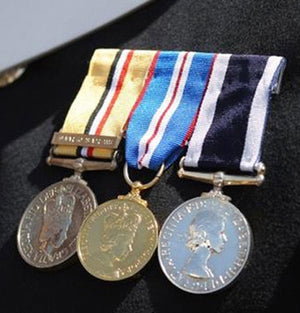
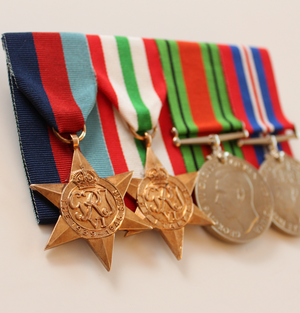
Court-mounted medal groups need particular care. Their rigid presentation bar can be wider than expected, and the medals should sit without pressure against the lid. If a group is already mounted, measure the overall width and height rather than relying only on the number of medals. A four-medal group from one period may occupy less space than three medals with broad ribbons or prominent clasps.
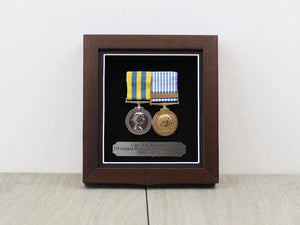
Miniature medals are often selected for mess dress, formal evening wear and collector display. Their smaller scale allows for more compact cases, but they still need a fitted interior that prevents movement. A loose miniature set can tangle easily, especially when stored with rosettes, ribbon bars or other insignia.
The exterior establishes the visual standard, but the interior does the protective work. A suitably padded, fitted lining holds medals securely and reduces the risk of abrasion during handling or transport. It should support the group without trapping pins, bending ribbons or placing pressure on delicate enamelled components.
Velvet-effect and similar soft linings are often appropriate for presentation, particularly where the box will be opened for family occasions or displayed in a home. For long-term storage, cleanliness and fit are more important than ornament. A case that looks impressive but allows medals to shift is not the best choice.
It is also worth considering whether the interior leaves room for accompanying paperwork. Some families wish to retain a citation, a copy of service details or a note explaining the recipient's connection to the medals. This should be stored separately if it creates pressure inside the case. Paper placed directly against medals can transfer moisture or marks over time.
A traditional dark finish is generally the most versatile choice for British military medals. It is restrained, formal and suitable for awards from every period, from Victorian and First World War groups through to contemporary operational, NATO and United Nations medals.
For a gift or retirement presentation, the case may be part of the ceremony itself. In that setting, a refined exterior and neat interior create a strong first impression without distracting from the medals. For a collector storing several groups in a cabinet, consistency may be more useful: matching cases make a collection easier to arrange and identify.
A presentation box can serve all three purposes, but the priority changes according to use. For a formal gift, appearance and a secure fit tend to lead the decision. For long-term storage, the focus should be protection from light, dust and repeated handling. For display, the box must balance visibility with sensible care.
Direct sunlight is rarely suitable for medals or ribbons. Ultraviolet light can fade fabric and affect the appearance of lining materials over time. A box displayed in a cabinet or on a shelf should therefore be kept away from bright windows, radiators and areas prone to changing humidity.
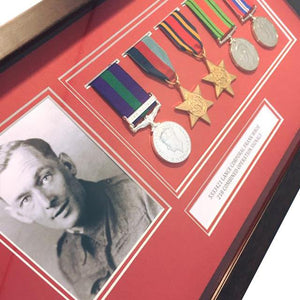
If the intention is to create a permanent wall display, a professionally framed arrangement may be preferable to a presentation box. Framing can incorporate medals, ribbons, cap badges, photographs and service details in one composed display. The trade-off is that a framed group is less convenient to remove for close inspection or ceremonial use. A presentation box is often better where the owner wants protection with the option of occasional handling.
A box should not be used to conceal preventable issues. Before placing medals inside, check that ribbons are clean, correctly folded and free from loose threads. Ensure clasps are properly fitted, pins close securely and no sharp elements are pressing into neighbouring medals or lining.
Where medals are tarnished, marked or have been stored poorly for many years, specialist cleaning should be considered before final presentation. Aggressive household polishing can remove detail, damage finishes and leave an unnatural shine. This is especially relevant for older die-struck medals, named awards and inherited groups where original surface character contributes to historical value.
Mounting should also be completed before the final box is selected. Swing mounting and court mounting produce different profiles, and a medal group that has been remounted may no longer fit its previous case. The same applies after adding an authorised clasp or replacing a damaged ribbon.
Empire Medals can assist with medal mounting, cleaning, engraving and bespoke display requirements, helping ensure that the case and the finished medals are suited to one another rather than chosen as separate afterthoughts.
Even the best case benefits from occasional checks. Open it carefully every few months, particularly if the medals are kept in a loft, garage or other area with fluctuating temperature. Look for signs of moisture, ribbon creasing, tarnish or movement within the lining.
Avoid storing presentation boxes in plastic bags or tightly sealed containers where condensation may become trapped. A dry, stable room inside the home is usually preferable. Handle medals by their ribbons or edges where possible, and ensure hands are clean and dry before opening the case.
For family medals, consider recording what is inside the box. A discreet note kept separately can identify the recipient, regiment or service, campaign, dates of service and any known family history. This small step can prevent an important story from being separated from the medals over future generations.
A presentation box is a practical safeguard, but it is also a mark of respect. When the medals are correctly mounted, carefully protected and presented with restraint, the service and history behind them remain clear for the next person who opens the lid.
Leave a comment