
Expert Support
Visit our Helpdesk
Visit our Helpdesk

A single named campaign medal can turn a family story into a piece of documented history. Pre-WW1 medals record service across the Victorian and Edwardian periods, from imperial campaigns and naval actions to long service, coronations and jubilees. For collectors and families alike, their value lies not only in the silver or bronze of the medal, but in the person, regiment, ship or unit connected to it.
These awards cover a broad period and should not be treated as one uniform category. The issuing authority, eligibility rules, naming style, ribbon and suspension all changed over time. Understanding those details is the best way to buy, preserve or display an early British medal with proper care.
In collecting terms, pre-WW1 medals generally refer to British and Commonwealth awards issued before the outbreak of the First World War in August 1914. The period includes some of Britain’s most recognisable campaign medals, beginning with early nineteenth-century awards and continuing through the Victorian Empire and Edwardian era.
Among the best-known are the Waterloo Medal, the Naval General Service Medal, the Military General Service Medal, the Crimea Medal, the Indian Mutiny Medal, the Ashantee Medal, the Egypt Medal, the Queen’s Sudan Medal and the Queen’s South Africa and King’s South Africa Medals. Each relates to a particular campaign or period of service, and many were issued with clasps that identify an action, region or date.
The category also includes awards that were not campaign medals in the strict sense. Army and naval long service and good conduct medals, volunteer awards, royal commemorative medals and police or civil awards can all fall within the period. Their purpose was different, but they are equally relevant to a complete collection or a family group.
A campaign medal is rarely just evidence that someone served overseas. Its design and entitlement often narrow the story considerably. The reverse may show the theatre of war, while the ribbon identifies the award at a glance. Clasps can be especially revealing.
A Crimea Medal, for example, may carry clasps for Alma, Balaklava, Inkermann or Sebastopol. A Queen’s South Africa Medal can carry a number of clasps reflecting particular actions, states or periods of service. The absence of a clasp is not automatically a concern: some recipients qualified only for the medal, and some awards were issued without clasps by design.
The rim naming is often the starting point for research. Depending on the medal and period, it may give a service number, rank, initials, surname and regiment or ship. Official naming is a significant part of originality and provenance. It should be read carefully, not assumed from a sales description or family recollection.
There are exceptions. Some medals were issued unnamed, some have officially impressed rather than engraved details, and privately engraved examples exist. A medal that appears unnamed or renamed requires closer assessment. It may still have historic interest, but it should be priced and described according to what can be established.
Clasps are not decorative additions. They are part of the entitlement and must match the recipient’s verified service where an original group is being assessed. A clasp added later can alter both the historical integrity and collector value of a medal.
This is why collectors should be cautious of a medal that has an unusually desirable clasp combination but limited supporting information. Conversely, a modest single-clasp medal with clear, traceable naming may be a far more satisfying acquisition. The right choice depends on whether the priority is rarity, regimental interest, family research or the visual appeal of a complete group.
The distinction between an original and a replica should always be clear. An original medal was issued in the period, or is a recognised officially issued later replacement. It may show age, wear and evidence of having been worn, but condition alone does not prove authenticity. Patina can be natural, altered or artificially created.
A quality replica serves a different purpose. It is appropriate where an original has been lost, where a family wishes to create a display without exposing an heirloom to wear, or where reenactment and ceremonial presentation require an accurate representation. A replica should never be represented as an original, and it should be clearly separated from original medals in a collection or frame.
For parade wear, a properly made replica can be the sensible choice, particularly for scarce Victorian campaign awards. It protects the original while retaining the correct appearance of the group. For collectors, however, originality of issue, naming, clasps and ribbon remains central to historic and financial value.
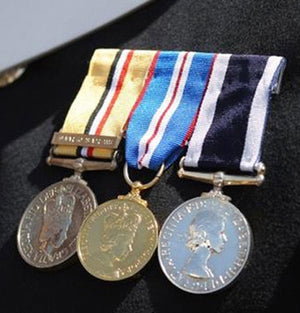
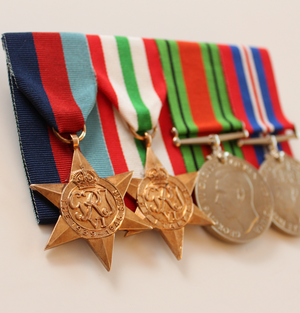
Medal groups deserve to be kept together wherever possible. A pair or group can show the course of a career in a way that one medal cannot: early campaign service, later long service recognition, and perhaps a commemorative award marking attendance at a royal event.
Start with the medals themselves. Check whether the ribbons are correct in colour, width and arrangement, and whether suspensions, clasps and naming are consistent with the issue. Replacement ribbons are common and can be entirely appropriate for display, but they should not be confused with period-worn ribbon.
Then consider the sequence. British medals are worn in an established order of wear, generally beginning with campaign and operational awards, followed by long service and good conduct awards, then commemorative medals. A group mounted in the wrong order may simply have been arranged by an inexperienced owner, but it should be corrected before ceremonial use.
Supporting material adds depth. Service papers, discharge documents, photographs, letters, medal rolls and regimental histories can all strengthen identification. Research does not always produce a complete answer, especially where common names are involved, but a service number, unit and date can often separate one man from another.
Early medals have survived for more than a century because families and collectors have often treated them with care. The same restraint is needed now. Do not use abrasive metal polish, household cleaning products or vigorous rubbing on an original medal. These can remove natural surface character, soften naming and leave bright, uneven patches that are difficult to reverse.
Handle medals by their edges where possible and keep them away from moisture, direct sunlight and extremes of temperature. Old ribbons are particularly vulnerable to fading, fraying and staining. If an original ribbon is weak, it may be better to retain it separately and use a correct replacement ribbon for mounting or display.
Cleaning, conservation and coating are different services. A light professional clean may be suitable for a medal affected by surface dirt or tarnish, while a stay-bright protective finish may suit a replacement or replica intended for regular wear. The right approach depends on the medal’s age, material, condition and intended use. An original named Victorian medal should always be treated more conservatively than a modern replacement set.
Medals worn on parade should be mounted securely and in the correct order of wear. Court mounting gives a neat, formal finish by securing the ribbon behind the medal, while swing mounting allows medals to move freely. Both have a place, although court mounting is often preferred for a tidy ceremonial presentation.
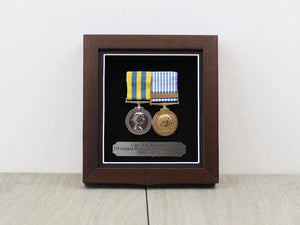
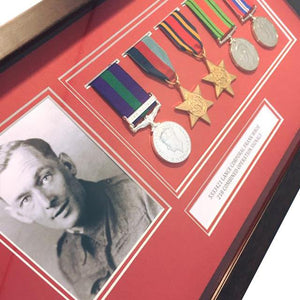
For an original pre-war group, mounting should not require irreversible alteration. Loose medals, original ribbons and associated documents may be better suited to a framed display. A well-planned frame can include the medals, copied service details, a photograph and a discreet caption without overcrowding the piece.
Avoid attaching originals with adhesive, drilling holes, or enclosing them against materials that may transfer acids over time. The best displays balance appearance with preservation. They allow the medals to be seen clearly while protecting the details that make them historically meaningful.
A medal with contact marks, a worn ribbon or a darkened surface may look less striking than a polished example, yet it can carry stronger evidence of genuine history. Over-restoration can make an early medal appear less convincing, not more. Collectors often prefer honest condition over an artificial finish.
Provenance also changes how a medal is understood. A named Queen’s South Africa Medal becomes more compelling when connected to a specific regiment and service record. A long service medal beside a campaign award may reveal decades of commitment. For a family, these details can turn an inherited object into a lasting connection with an ancestor’s service.
When choosing presentation, replacement or preservation work for pre-WW1 medals, begin with the medal’s story and intended future. A careful decision now helps ensure that the names, service and craftsmanship behind these awards remain clear for the next generation.
Leave a comment