
Expert Support
Visit our Helpdesk
Visit our Helpdesk

A medal group tells a service story at a glance: the campaigns served, the years given and, sometimes, the family members who carried that history forward. The best military shadow box ideas begin with that story rather than with the frame itself. A well-planned display should look dignified, protect the items within it and present medals in a way that respects their correct order and significance.
A shadow box is particularly suited to medal groups because its depth allows medals, ribbons, badges and carefully chosen service keepsakes to be displayed without being pressed against the glazing. It can become a permanent family heirloom, a retirement presentation or a considered way to preserve a collection that deserves more than a drawer or album.
Before selecting a case, identify exactly what is being displayed. A single campaign medal requires a different approach from a full mounted group, a gallantry award or a collection spanning several generations. The number of items, their size and the condition of original ribbons all affect the final layout.
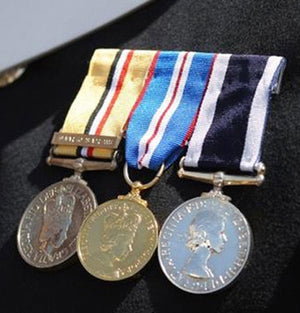
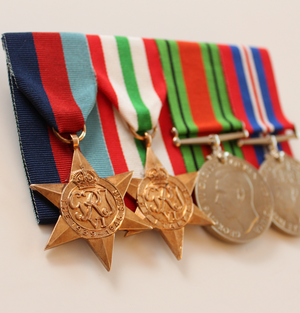
For British medals, the order of wear must be established before any mounting or framing work begins. This is not merely a design preference. It preserves ceremonial accuracy and makes the display immediately legible to serving personnel, veterans and collectors. If the group has already been court mounted or swing mounted, it is usually best to retain that arrangement rather than dismantling it for a frame.
Original medals and replacement or replica medals also call for different decisions. An original group may have strong family and historical value, so minimal handling and conservation-minded framing are sensible. MoD Licensed Replica Medals can be a practical choice for a display intended for a public space, a reunion or a commemorative presentation, while the originals remain safely stored. The right route depends on the purpose of the box and the value attached to each item.
The most effective military shadow box ideas are selective. Filling every spare inch with objects can obscure the medal group, which should normally remain the focal point. Choose supporting pieces that add context without turning a service record into decoration.
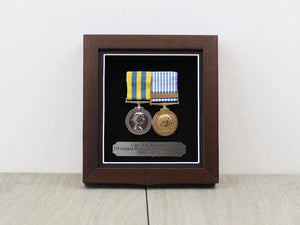
For a clean, ceremonial presentation, place mounted full-size medals centrally against a neutral fabric backing. Deep navy, black, charcoal or a restrained service-colour tone often works well, provided it does not compete with the ribbons. A name plate beneath the group can record the recipient's rank, name, service number if appropriate, regiment or corps, and dates of service.
Ribbons may be shown above the medals where space permits. This makes it easier to identify awards at a distance and can be especially useful in a display for younger family members who are learning the history behind the group. Keep spacing generous. A medal group needs room around it to retain its formal character.
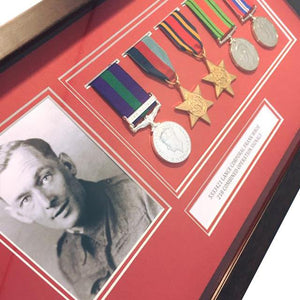
A larger case can trace an entire career, beginning with medals in their correct order and adding a cap badge, qualification badge, rank insignia or a small unit photograph. A formal studio portrait or a carefully copied service photograph often provides more meaning than several unrelated souvenirs.
Use documents sparingly. An original certificate, parchment or discharge document is often better preserved separately in archival storage, with a high-quality copy placed in the box. This protects a vulnerable paper item from light exposure while still allowing the display to record key details of the recipient's service.
Where a group relates to a particular conflict or operational tour, a campaign-led layout can be appropriate. The medal group should remain central, with a period photograph, unit insignia and a concise engraved caption giving the campaign and dates. This works well for displays relating to the World Wars, Korea, the Falklands, Gulf service, Iraq, Afghanistan, NATO operations or United Nations service.
Restraint matters here. Maps, newspaper cuttings and insignia can be valuable context, but too many items make the case look like a noticeboard. One or two strong supporting pieces will usually do more than a crowded collection of material.
When medals have passed through several generations, arrange each person's group in a separate horizontal band or vertical panel. Clearly label names and relationships so the viewer can follow the family's service history. A small genealogy note is useful, particularly where surnames, regiments or eras differ.
It is worth distinguishing between original medals, officially named replacements and commemorative or replica pieces. Clear labelling protects historical accuracy and prevents later confusion. A display should honour every individual's service without suggesting that every item has the same provenance.
A frame may look excellent on the day it is made and still be unsuitable for long-term preservation. Medals, ribbon and paper can be affected by humidity, direct sunlight, adhesive residues and materials that release harmful chemicals over time.
Choose a deep, well-made case with secure backing and glazing that keeps dust away. UV-filtering glass or acrylic is worth considering for a display that will hang in a bright room, though no medal display should be positioned in sustained direct sunlight. Avoid lofts, garages, conservatories and external walls where temperature and moisture levels can fluctuate sharply.
The backing should be firm enough to support the weight of a medal group without sagging. Textile-covered boards give a traditional appearance, but the fabric and board should be suitable for display use rather than improvised from household materials. Avoid ordinary cardboard, foam that may degrade, pressure-sensitive tape and glue applied directly to medals or ribbons.
Fixings deserve equal care. Medals should be supported by methods that do not strain the ribbon, pierce the metal or leave permanent marks. If you intend to wear the medals again, a removable support system may be more suitable than a permanently fixed display. If the case is purely commemorative, professional framing can provide a more secure and refined finish.
A common mistake is ordering a box before measuring the mounted group. Measure the full width and drop of medals, then allow enough clear space around them for a balanced border. Remember that full-size medals project forward, especially when court mounted, and need adequate internal depth so that the glazing does not rest against the suspensions or ribbon.
Lay out paper templates before committing to the final arrangement. This makes it easy to test the relationship between medals, badges and captions. The eye should naturally settle on the medals first, then move to the supporting elements. If a photograph or large cap badge overwhelms the group, reduce its size or move it to one side.
Engraved plates are often preferable to printed labels for permanent displays. Keep the wording factual and concise. Rank, name, service, unit and dates are generally sufficient. Where space allows, add the campaign title or a short line such as “With grateful pride”. Avoid trying to place a full biography inside the case; a separate written record can preserve the wider story.
A home-made display can be entirely suitable for a straightforward ribbon bar, badge collection or replica presentation. Professional help becomes particularly valuable when handling original medal groups, fragile ribbons, named awards, inherited collections or items of significant financial and sentimental value.
A specialist can advise on medal mounting, correct order of wear, suitable case depth and a layout that remains secure over time. This is also useful where medals need cleaning, stay-bright coating, engraving or restoration before display. Cleaning should never be treated as automatic: original patina may be historically appropriate, and overly aggressive polishing can reduce collector interest or alter an item's character.
Empire Medals provides specialist medal mounting and bespoke framing services for customers who want a properly finished presentation without compromising ceremonial accuracy. The benefit is not simply a neater result. It is confidence that the medals and their supporting details have been treated with the care their history warrants.
Once the shadow box is complete, record what it contains. Keep a note of medal names, entitlement, service details, provenance and any family recollections in a separate folder. Future custodians may recognise the medals, but they may not know why they were awarded or how they came into the family.
Place the finished case where it can be seen and appreciated, but away from strong light, damp and excessive heat. A carefully made military shadow box should do more than decorate a wall. It should give a service record a proper place in the home, ready to be understood and remembered by those who see it next.
Leave a comment