
Expert Support
Visit our Helpdesk
Visit our Helpdesk

A medal may carry a campaign name, a service number and the marks of age, yet none of these alone proves its history. Knowing how to verify medal provenance means building a chain of evidence: from the object itself, to the recipient, to the entitlement, and finally to the route by which it reached its present owner. This is particularly important when assessing named British campaign medals, gallantry awards and complete family groups.
Provenance does not always arrive in a neat envelope with official papers. Many genuine medals have passed through families with little documentation, while some well-presented groups have been assembled from unrelated pieces. The aim is not to demand perfection, but to distinguish sound evidence from a persuasive story.
Provenance is the documented or credible ownership history of an individual medal or group. It can establish that a medal was issued to a particular person, that it remained with their family, or that the medals in a group have stayed together over time.
This is different from authenticity. A medal can be an authentic period issue but have no proven family history. Equally, a medal can have an excellent-looking family note but be incorrectly named, reconstituted or altered. Both authenticity and provenance need examination.
It is also worth separating entitlement from ownership. Service records, medal rolls and official notices may confirm that an individual was entitled to an award. They do not automatically prove that the medal now offered for sale was the one issued to them. Strong provenance joins these two strands wherever possible.
Before reading a dealer description or family account, examine the physical medal closely. The naming around the rim or edge is often the most useful starting point on British campaign medals. Check the spelling of the recipient’s name, initials, rank, unit and service number against the style expected for that issue.
Naming conventions changed by period and service. Some medals were officially impressed, some engraved, and some issued unnamed. Variations do exist, so an unfamiliar style is a reason for further research rather than an automatic rejection. However, uneven lettering, fresh tool marks, altered numerals or a surface that differs markedly around the naming should prompt caution.
Look beyond the inscription. Compare the obverse and reverse detail, suspension, ribbon ring, edge thickness and overall weight with known examples of the same issue. Wear should make sense across the medal. A heavily worn rim beside sharp, bright naming, for example, deserves closer inspection.
A ribbon is useful supporting evidence but rarely proof in its own right. Ribbons are routinely replaced for wear, mounting or display. Correct replacement ribbon can improve presentation without making an original medal less genuine, provided it is described honestly.
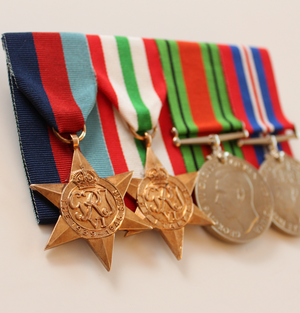
When assessing a medal group, ask whether the awards are plausible for one career. The dates, theatres of service, rank and branch of service should align. A First World War pair, for instance, may reasonably be accompanied by a later long-service award if the recipient’s service continued, but each addition should be capable of explanation.
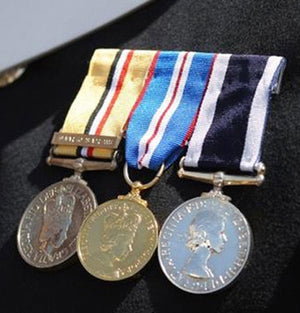
Pay attention to mounting. Court mounting can conceal reverse details and may have been carried out long after issue. That is not a fault in itself. Professional mounting is often a practical and respectful choice for family wear or display, but it should not be used to avoid scrutiny of naming, clasps or condition.
Once the physical details have been recorded, research the recipient. Begin with the exact information on the medal: service number, initials, surname, rank and unit. Service numbers are especially valuable because names can be common, initials can vary and promotions may alter the rank shown in later documents.
For many British medals, medal rolls provide the clearest confirmation of entitlement. They may record campaign awards, clasps, regiment or corps, and sometimes a roll and page reference. Service records can add enlistment dates, postings, wounds, discharge details and next-of-kin information. For gallantry awards, official notices and citations may provide an additional level of evidence.
Records should match the medal rather than merely resemble it. If a roll confirms an award to J. Smith of a particular regiment, but the medal is named to a different service number or unit, the discrepancy matters. It may be a transcription error, a later transfer, a renamed medal or simply the wrong man. Treat it as unresolved until supported by better evidence.
Some records are incomplete, damaged or subject to access restrictions. This is common, particularly for twentieth-century service. In those cases, use several sources together: contemporary photographs, pay books, discharge papers, letters, newspaper notices, unit histories, obituary notices and family correspondence can all help establish a credible account.
The strongest provenance usually includes paperwork that connects the recipient to the medal and the seller to the recipient. Original medal boxes, forwarding slips, award certificates, named photographs and correspondence are valuable because they were created close to the time of issue.
Family provenance can also be entirely credible without official issue documents. A clear account from a descendant, supported by photographs or estate papers, may be persuasive. Record names, dates and relationships where possible. A note stating “Grandad’s medals” has emotional value, but is weaker evidence than a note identifying the recipient, their unit and how the medals passed through the family.
Auction catalogues and dealer invoices can support a later ownership chain, especially where they include clear photographs, full naming and a detailed description. They cannot replace primary evidence of issue, but they can show that the medal has been known and consistently described over a number of years.
Be wary of broad claims that cannot be checked: “from an old collection”, “direct from the family” or “found in a house clearance”. They may be true, but they are not provenance on their own. A reputable seller should be willing to state what is known, what is inferred and what remains unverified.
No single warning sign proves a medal is wrong. Several small inconsistencies, however, can form a clear pattern. Take particular care where there is altered naming, an unusually rare clasp with no supporting record, an entitlement that does not match the recipient’s service, or a group whose awards span incompatible periods.
The following situations merit further research before purchase:
Rare gallantry awards, casualty medals, unusual clasps, Victorian issues and high-value groups justify specialist scrutiny. Good research may require comparing naming styles, consulting rolls, understanding regimental changes and interpreting partial service evidence. The cost of informed advice is modest compared with the risk of acquiring a wrongly attributed medal.
For medals intended for wear, there is another practical distinction. A MoD licensed replica or British-made die-struck replacement medal serves a legitimate ceremonial purpose, but it does not carry the provenance of an original issued award. It should be described and displayed accordingly. This clarity protects both the history of the original recipient and the integrity of modern presentation.
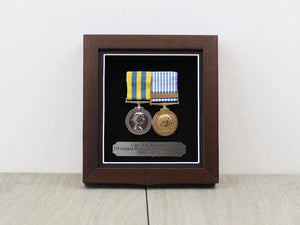
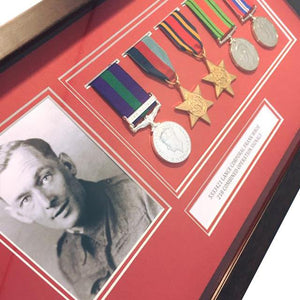
If you inherit medals, photograph both sides before cleaning, mounting or framing them. Keep boxes, letters, ribbons and even small handwritten notes together. A professional display can preserve a family story beautifully, but the supporting material should be stored safely alongside it rather than discarded.
The best provenance is rarely dramatic. It is a quiet agreement between the medal, the records and the family or collecting history. Take the time to follow that evidence carefully, and you preserve more than an object: you protect the service and memory it represents.
Leave a comment