
Expert Support
Visit our Helpdesk
Visit our Helpdesk

A medal left in a drawer is safe enough, but it is not really seen. A medal on display carries its full weight - service, sacrifice, family memory and historical detail all in one place. If you are deciding how to frame war medals, the right approach is less about decoration and more about preservation, accuracy and respect.
Framing medals is not the same as framing a photograph or certificate. Metal, ribbon, cloth and paper all age differently, and a poor display can cause fading, tarnishing or strain on the suspender and ribbon. A well-made frame protects the medal set while presenting it clearly, whether it is a single campaign medal, a mounted group or a family display that includes cap badges, photographs or service documents.
The first decision is what exactly you are framing. A single loose medal calls for a different method from a court-mounted group, and original issue medals should be handled more cautiously than modern replicas intended mainly for presentation. If the medals are named, engraved or associated with a particular casualty, regiment or campaign, that historical value should shape the display from the outset.
It is usually best to begin with condition. Check the ribbons for fraying, splitting or weakness around the brooch or suspender. Look at the medals themselves for active corrosion, dirt build-up or signs of previous polishing. If a ribbon is brittle or a medal has loose fittings, forcing it into a tight frame can do more harm than good. In those cases, some light conservation or professional mounting is the sensible first step.
The frame itself needs to be deep enough for the medals to sit naturally without pressing hard against the glass. Standard picture frames are often too shallow, particularly for mounted groups or medals displayed with clasps. A box frame is generally the better choice because it allows space between the glazing and the medals, which reduces pressure on the ribbon and helps avoid abrasion.
Backing materials matter more than many people realise. Acid-free boards and conservation-grade mounts are worth using because ordinary card can discolour ribbons over time. Dark backing colours are often chosen because they show silver and bronze well, but colour should not overpower the display. Navy, black, deep bottle green and burgundy are all traditional choices, though the best option depends on the ribbon colours and whether the frame is intended for a domestic setting, a regimental display or a collector’s cabinet.
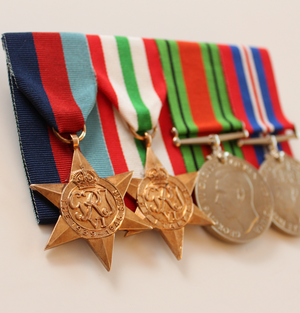
The neatest display is not always the most correct one. If the medals were officially mounted for wear, keeping that order and spacing usually makes sense. If they are loose, they should be arranged according to the proper order of wear, with campaign and service precedence observed correctly. For many families, this is where uncertainty starts, especially if the group spans different theatres or periods.
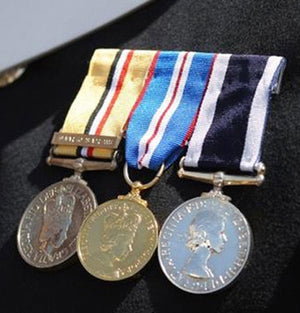
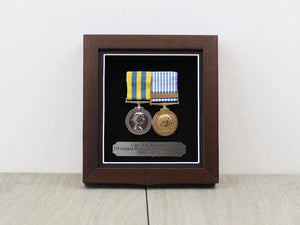
A single medal can sit centrally with generous space around it. A pair or trio often looks best in a straight line, while larger groups need careful spacing so that clasps, dates and naming remain visible. If a frame becomes overcrowded, the medals lose definition. It is often better to use a slightly larger frame than to compress the set just to fit a shelf or wall space.
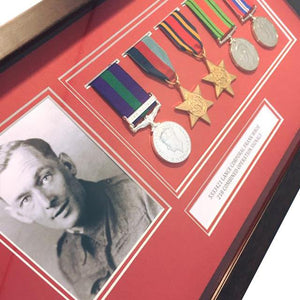
There is also the question of whether to include related items. Photographs, service records, cap badges, unit flashes and a small engraved plaque can add context, but only if they support the medals rather than compete with them. Too many additions can turn a military display into a scrapbook. A strong frame usually has one clear focal point, and in most cases that should remain the medals.
If you are framing a group for family presentation rather than strict collecting, a photograph of the recipient in uniform can be especially effective. It gives identity to the display and helps younger relatives understand that these were not just objects, but honours earned by a real person in service.
The glazing is not just there to keep dust out. Light is one of the biggest long-term risks to medal ribbons, particularly older silk and cotton examples. Direct sunlight can fade colours unevenly, and once that fading occurs it cannot be reversed. UV-protective glazing is therefore a sensible upgrade for original medals and ribbon bars.
There is a trade-off. Standard glass is cheaper and perfectly serviceable in many settings, but it offers less protection. Acrylic is lighter and less prone to shattering, which may suit posted gifts or larger frames, though it can scratch more easily than glass. For heirloom pieces, clarity and protection should come before the lowest price.
Placement matters as much as glazing. Even a well-framed set should not be hung opposite a bright window, above a radiator or in a damp room. Hallways, studies and sitting rooms tend to be better than lofts, conservatories or garages. Medals cope best in a stable environment.
The safest way to secure medals in a frame depends on whether they are court mounted, swing mounted or loose. Adhesives should generally be avoided on the medal or ribbon itself. Glue can stain textile fibres, harden over time and make future conservation difficult. Pins, discreet stitching and proper mounting supports are usually the better approach when done by someone who understands medal construction.
Loose medals should never simply be taped onto a backing board. That may hold them for a short while, but it is not a preservation method. Equally, medals should not be suspended in a way that puts constant strain on a weakened ribbon. Good framing supports the weight properly and keeps the set level.
For mounted groups, many owners prefer to frame the medals exactly as worn. That preserves ceremonial correctness and often gives the cleanest presentation. If the medals are not yet mounted, it may be worth having them professionally court mounted before framing, particularly if the recipient or family also wants the option of wearing them on formal occasions.
Not every framed set has the same purpose. Some are intended to preserve originals with as little intervention as possible. Others are created for presentation, remembrance or duplicate display, using replica medals while the originals remain stored securely. That can be a practical choice where the family wants a display piece but does not want to expose valuable or fragile originals to light and handling.
There is no single correct answer here. Collectors may prefer original groups in conservation framing, while families often value a balanced display that includes copies, documents and photographs. The key is to be clear about the objective before the work starts. Preservation, ceremonial accuracy and visual impact do not always pull in exactly the same direction, so framing decisions should reflect what matters most.
This is also why specialist support can be worthwhile. A medal frame is only as good as the judgement behind it - correct order, suitable materials, appropriate spacing and secure mounting. For buyers dealing with British campaign groups, named medals or bespoke presentation pieces, a specialist service such as Empire Medals can remove a lot of uncertainty.
The most common mistake is using an ordinary off-the-shelf frame and assuming all display materials are harmless. Another is polishing medals before framing them. Light cleaning may be appropriate in some cases, but aggressive polishing can remove surface character and, on named or older pieces, reduce historic integrity.
It is also easy to overfill the frame. A medal group needs room. If there are too many associated items, consider separate displays rather than forcing everything into one crowded arrangement. Finally, do not overlook the reverse. If the naming on the rim or reverse detail matters, think carefully about whether a standard front-facing display tells the whole story. In some cases, a caption or separate record of the naming is a sensible addition.
A well-framed medal display should look settled, balanced and respectful. It should not feel improvised.
If you are taking the time to preserve service history, it is worth doing in a way that will still look right ten or twenty years from now. The best frame does more than hold medals on a wall - it gives them a proper place in the story of the person who earned them.
Leave a comment