
Expert Support
Visit our Helpdesk
Visit our Helpdesk

A medal group can be historically correct, beautifully made and immaculately polished, yet still look wrong if the ribbons are out of order or poorly aligned. Knowing how to arrange medal ribbons is therefore about more than appearance. It protects the meaning of each award, respects the recipient's service and ensures the group is suitable for ceremonial wear.
Whether you are preparing your own medals for a parade, replacing a lost group, or preserving a family member's awards, begin with the official order of wear. Do not arrange ribbons by campaign date alone, by personal preference or by the visual balance of their colours. British military and civilian decorations follow an established order of precedence, and that order is the foundation for every correctly presented group.
Before mounting or sewing anything, identify every medal and confirm that it is properly entitled. This is especially important with inherited groups, replacement medals and campaign awards that may appear similar at first glance. Check the medal's name, the correct ribbon, any clasp entitlement and whether the award is British, Commonwealth, foreign or an approved commemorative issue.
The most senior award is worn nearest the centre of the chest. The remaining medals follow in their official order of precedence, progressing outwards towards the left arm. This rule applies to full-size medals, miniature medals and ribbon bars, although the form of mounting and the permitted occasions for wear differ.
It is sensible to keep a written record of the final order before work begins. Include the full title of each medal, the ribbon description, clasps and any post-nominal letters where relevant. A clear record is useful for future remounting, insurance, family history and display framing.
British orders of wear can be more complicated than they first appear. Decorations, gallantry awards, campaign medals, Jubilee or Coronation medals, long service awards and authorised foreign awards do not simply follow the date on which they were received. Current service dress regulations should always take priority for serving personnel. Veterans attending a formal event should also follow the guidance issued by the relevant service association or organiser where it is available.
Full-size medals are normally worn on the left breast for formal day dress and ceremonial occasions where medals are prescribed. The ribbons must lie flat, with the correct colour sequence visible at the top of each medal. A ribbon fitted upside down, twisted behind the suspender or cut to an uneven length can quickly detract from an otherwise correct group.
First, place the medals in precedence order on a clean surface. Check each ribbon against a reliable reference before it is folded around the mounting bar. This is particularly worthwhile for striped ribbons, where a narrow edge stripe or centre stripe may make the correct orientation less obvious.
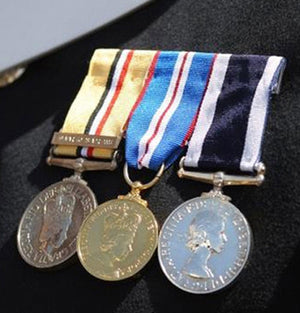
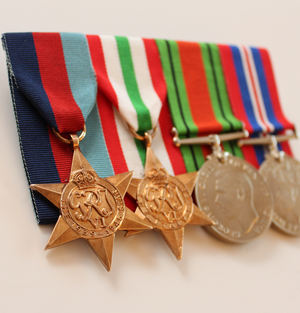
The number of medals determines the width and arrangement of the bar. A small group may sit comfortably in one row. Larger groups are often overlapped so that the medals remain contained within a practical width across the chest. The senior medal should still remain nearest the centre, even where medals overlap.
There are two recognised styles of mounting. Swing mounting allows medals to move freely from their individual ribbon bars. Court mounting secures the medals against a backing board, producing a neat, stable finish that is often preferred for parades, formal functions and long-term presentation. Neither style changes the order of wear. The choice depends on service requirements, the occasion and personal preference.
Court mounting is particularly useful for groups containing several medals, where loose medals may knock together, turn awkwardly or sit unevenly. A properly made court-mounted group has carefully folded ribbons, secure medal fixing and a level finish. The reverse should be as tidy as the front, with no visible loose thread, adhesive residue or strained fabric.
A ribbon bar is not a decorative substitute for medals. It is an authorised representation of awards, generally worn with forms of uniform when full-size medals are not prescribed. The ribbons must appear in exactly the same order of precedence as the corresponding medals.
Each ribbon is cut to the standard width for the relevant bar and set edge to edge. Where more ribbons are held than can fit comfortably in one row, they are arranged in rows according to the service's regulations. The layout, maximum number per row and method of spacing can vary between the Royal Navy, British Army, Royal Air Force and other uniformed organisations. It is not wise to copy a layout from an old photograph or another person's uniform without checking the applicable instructions.
Keep the bar straight and level. The top and bottom edges should be clean, the ribbon sections should not bow or fray, and each colour should be evenly exposed. If an emblem, rosette or device is authorised for wear on a ribbon bar, it must be placed in the correct position and be appropriate to that particular award.
For civilian medal groups, the principle remains the same: establish the authorised order first, then ensure the ribbons are neatly mounted and consistently aligned. Civilian awards may be worn under different rules from service medals, so the event's dress code matters.
Clasps form part of the medal's history and should never be treated as an optional detail. A campaign clasp must match the recipient's confirmed entitlement and sit securely on the medal ribbon. Do not add a clasp simply because it was available for the campaign, and do not remove an entitled clasp to make a group look simpler.
The same restraint applies to emblems and ribbon devices. Some awards have authorised additions that indicate a further period of service, an additional award or a specific distinction. Others do not. If there is uncertainty, research the individual award before altering the group.
Miniature medals follow the same precedence as full-size medals but are made for evening dress and occasions where miniatures are appropriate. They are not simply smaller decorative versions of full-size medals. Their ribbons, mounting width and style of wear should be proportionate to miniature dress. Mixing full-size medals and miniatures in the same mounted group is incorrect.
Once arranged, inspect the medals from the front and reverse. The ribbon colours should be clean and unfaded, medals should hang at a uniform level, and the mounting should sit flat against the garment. Lightly brush away dust and use a soft cloth only where appropriate for the medal's material. Aggressive polishing can damage original finishes, remove desirable patina or affect engraved details.
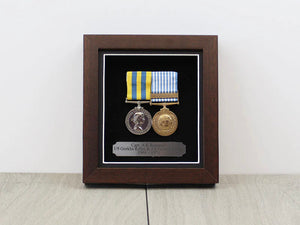
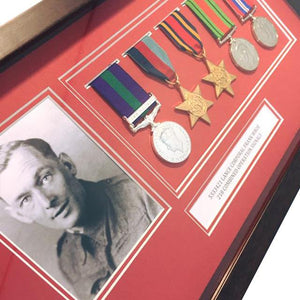
Avoid storing medals in damp lofts, garages or direct sunlight. Ribbon is susceptible to fading, while metal can tarnish in poor conditions. If the group is not regularly worn, a lined presentation case or professionally framed display gives better protection than leaving it loose in a drawer.
A professional mounting service is often the right choice when a group is large, historically significant or intended for a major ceremonial occasion. Skilled mounting ensures that the ribbons, medals, clasps and backing are handled with the consistency expected of a parade-ready or commemorative group. Empire Medals provides specialist medal mounting and presentation services for customers who want an accurate, British-made finish.
A correctly arranged medal group should look calm rather than crowded: seniority clear, ribbons level and every detail secure. When the work is done with care, the medals remain what they should be - a dignified record of service, ready to wear, preserve or pass on.
Leave a comment