
Expert Support
Visit our Helpdesk
Visit our Helpdesk

A medal group can be entirely genuine, correctly named and in the right order, yet still look unfinished if it is mounted in the wrong style for its purpose. The choice between court mounted vs swing mounted medals affects how a group sits on the chest, moves on parade and is preserved for years to come. It is also a decision that should respect service dress requirements, the character of the medals and the wearer’s personal preference.
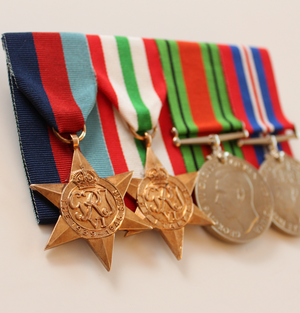
Swing mounting is the traditional arrangement most people recognise. Each medal hangs from its ribbon on a suspension bar and moves independently. The ribbons are generally displayed at their full visible length, with the medals sitting freely beneath. When worn, the group has natural movement - hence the name.
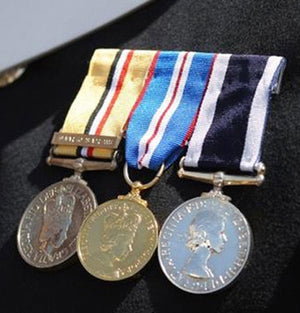
Court mounting secures the medals against a shaped, stiffened backing. The ribbons are folded and mounted neatly, often with medals overlapping where necessary to create an even line. The group is held close to the garment and remains largely still when worn. It produces a compact, formal finish that is particularly familiar on modern service dress and ceremonial uniforms.
Neither method changes the medal itself, the wearer’s entitlement or the order of wear. The difference is in presentation, movement and practical suitability.
A swing-mounted group gives every award its own presence. The medals hang freely and can be seen in full, which makes this style especially appealing for groups with distinctive reverse designs, unusual suspensions or historical significance. It is a natural choice for many collectors, family displays and those seeking a period-correct appearance for earlier medal groups.
On wear, swing-mounted medals move as the wearer walks or turns. That is part of their traditional character, but it also means medals can strike one another. Over time, repeated contact may mark surfaces, wear ribbon edges or create small chips in enamelled or plated finishes. For a group worn regularly, this is worth considering.
Swing mounting can also occupy more width across the chest, particularly when several full-size medals are present. A modest pair or trio usually hangs cleanly. A larger group can spread, overlap unevenly or sit less securely unless it has been mounted with care.
For many original First and Second World War groups, swing mounting remains the historically sympathetic approach. It allows the medals to retain the appearance in which they were commonly worn, particularly where a family wishes to preserve the style of an existing group rather than create a newer ceremonial finish.
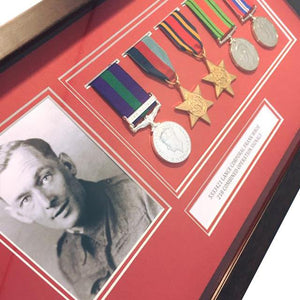
Swing mounting is often preferred when historical presentation is the priority, when the group is intended primarily for framing or collecting, or when the medals are few enough to hang comfortably without crowding. It may also suit reenactment, provided the arrangement matches the period and impression being represented.
A free-hanging group should still be professionally assembled. Correct spacing, ribbon length, bar alignment and secure fixing make a considerable difference to how medals wear and how confidently they sit on a jacket.
Court mounting was developed to give a larger medal group a tidy, uniform appearance. The ribbons are set over a firm backing, and medals are positioned to form an even lower edge. This may involve overlapping some medals, particularly where a wearer has a longer group. The result is close-fitting, controlled and highly suitable for ceremonial wear.
Because the medals do not swing against each other, court mounting offers greater day-to-day protection from contact damage. It can be an excellent solution for medals worn at parades, remembrance events, regimental occasions and formal dinners. A well-mounted court bar also tends to remain neater while the wearer is moving, saluting or standing on parade.
The appearance is more structured than swing mounting. Some wearers favour this crisp finish for modern groups, especially where several campaign, Jubilee, Coronation, NATO or United Nations medals need to sit in a restricted space. Others prefer the visible separation and movement of swing mounting. Both preferences are valid, provided the finished group meets the relevant dress expectations.
Overlap is sometimes misunderstood as a compromise. In fact, it is a recognised part of court mounting and is used to maintain a balanced row. The amount of overlap depends on the number, diameter and shape of the medals, as well as the order in which they must be worn.
The first and last medals may remain more visible, while those in the centre can sit partially behind neighbouring awards. A skilled mounter plans the layout so that the group is level, secure and respectful of each medal’s ribbon and suspension. The objective is not simply to make the bar smaller, but to create a properly proportioned ceremonial group.
Start with the reason the medals are being mounted. If they will be worn regularly on formal occasions, court mounting is often the practical choice. It is stable, compact and less prone to medals knocking together. If the group is principally a historical keepsake, an inherited set or part of a collection, swing mounting may better preserve its original visual character.
The size of the group matters too. A single medal, pair or small trio can look excellent in either style. As the number increases, court mounting becomes increasingly attractive because it controls the width and alignment. This is particularly relevant with full-size medal groups, which can become substantial when mounted conventionally.
Existing presentation is another consideration. If a family medal group has been swing mounted for decades, converting it to court style may alter its established appearance. Conversely, a mixed or poorly assembled group can benefit greatly from being remounted to a consistent professional standard.
It is generally best not to combine court-mounted and swing-mounted medals within one group. A medal bar should look deliberate and uniform. Where an older group presents unusual mounting, unofficial additions or a previous repair, specialist advice is preferable to making assumptions.
Personal preference has a place, but military dress regulations take precedence for serving personnel. Requirements can vary by Service, unit, dress order and occasion. Before arranging a new medal bar for wear, check current guidance through the appropriate chain of command, unit administration office or dress regulations.
Veterans and family members do not always face the same requirements as serving personnel, but a formal standard remains valuable. Medals should be in the correct order of wear, with ribbons accurately matched and clasps properly fitted. This matters just as much whether the medals are MoD Licensed Replica Medals, original named awards or British-made replacement pieces.
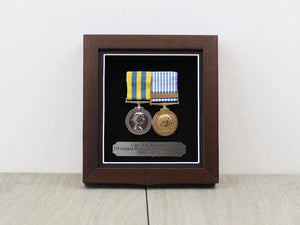
Miniature medals follow the same broad choice. Court-mounted miniatures offer a particularly neat result for mess dress and black-tie occasions, while swing-mounted miniatures retain a more traditional free-hanging style. The smaller scale makes precise alignment essential in either format.
A medal bar is not merely an accessory for an occasion. It is a presentation piece that may remain with a family for generations. Good mounting protects the group from unnecessary strain, keeps ribbons cleanly arranged and allows each award to be displayed with dignity.
Before work begins, check the condition of the medals, ribbons and clasps. Original ribbons can fade, fray or carry creases from years of storage. Replacing a worn ribbon may improve the finished appearance, but some families wish to retain every original component. There is no single answer: the right approach depends on whether historical originality or a parade-ready result is the greater priority.
Engraving, cleaning and protective finishing should also be considered carefully. Cleaning can improve presentation, but excessive polishing may remove the aged character collectors value. A thoughtful mounting service will treat an original campaign medal differently from a modern replacement intended for frequent wear.
Empire Medals provides specialist medal mounting for customers who need a correctly ordered, professionally finished group, whether the aim is formal wear, respectful restoration or a family presentation.
Court mounting offers stability, a compact profile and a formal ceremonial appearance. Swing mounting preserves traditional movement and can be the more sympathetic choice for historical groups. The best decision is the one that respects the medals’ period, the wearer’s requirements and the purpose for which the group will be kept or worn.
If there is any uncertainty, pause before altering an inherited group or ordering a new mounting. A careful assessment of the medals, ribbons, order of wear and intended occasion will ensure the finished bar does justice to the service it represents.
Leave a comment