
Expert Support
Visit our Helpdesk
Visit our Helpdesk

A Naval General Service Medal named to an Able Seaman, a campaign star found in a family drawer, or a group bought at auction can carry far more meaning than its metal and ribbon suggest. Naval medal provenance is the evidence that connects an award to the person who received it, the service they gave and the route by which the medal has reached its present owner. Where that connection is sound, it protects historical value and preserves a personal record that cannot be replaced.
For collectors, families and naval heritage researchers, provenance should be treated as part of the medal itself. A correctly named, properly documented original award tells a coherent service story. A loose medal without supporting history may still be genuine, but there is less certainty about the individual behind it and, occasionally, about the medal’s integrity as issued.
Provenance is a documented ownership and service history. In the strongest cases, it begins with official entitlement and naming, then follows the medal through family descent, sale records, collection notes or other reliable records. It is not simply a verbal assurance that a medal “came from a naval family”.
For British naval awards, the starting point is usually the recipient’s details. Depending on the period and award, the rim or reverse may carry a name, rank or rating, service number, ship, unit or date. Those details can often be compared with medal rolls, service records, gazettes, ship histories and campaign entitlement. The more independently supported facts there are, the clearer the provenance becomes.
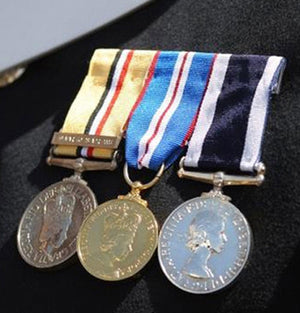
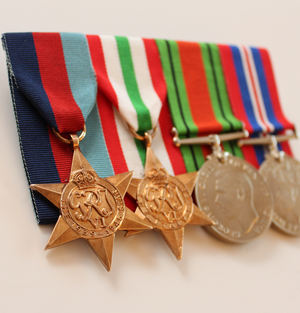
A complete medal group is especially valuable in this respect. Stars, campaign medals, long service awards and commemorative issues worn together can show the outline of a career. However, a group should not be assumed to be original merely because its combination looks plausible. Medals may have been assembled later, remounted, replaced or supplemented. Careful research distinguishes a documented group from an attractive arrangement.
The first reason is authenticity. Original British medals were issued to specific people under specific conditions. Confirmation that a named sailor served in the relevant ship or theatre, and was entitled to the award, provides much stronger confidence than appearance alone.
The second is historical significance. Two apparently identical medals may have very different interest. A standard campaign award to a rating can become a remarkable piece of naval history when it is tied to a particular action, convoy, landing, deployment or ship. Provenance turns an object into evidence of service.
It also affects value. Market value is never determined by provenance alone - condition, rarity, demand, naming style and the completeness of a group all matter - but good documentation commonly increases confidence and desirability. Conversely, a medal with erased naming, doubtful engraving or a story unsupported by records deserves greater caution.
For families, the value is often personal rather than financial. Establishing which relative earned a medal can correct long-held assumptions, identify a ship photograph, or preserve the right account for children and grandchildren. That work is worth doing before names, paperwork and memories are lost.
Begin by recording exactly what is in hand. Photograph the obverse and reverse in clear natural light, along with the rim naming, ribbon, clasp, suspension and any case or paperwork. Do not polish a medal before making this record. Surface marks, original toning and old mounting details may all provide useful context.
Transcribe the inscription precisely, including initials, punctuation, abbreviations and service numbers. A small discrepancy can matter. Naval naming conventions changed across periods, and records may list a man under a different form of his name, a former rating, or an abbreviated ship designation.
Next, separate evidence by strength. Official service papers, medal rolls, original issue slips, award citations, photographs showing the recipient wearing the medal, and contemporary letters are strong evidence. Old dealer tickets, auction catalogues and family notes can be useful supporting material, but should not be treated as proof without corroboration.
A practical research file should keep digital copies of photographs and documents, alongside notes explaining where each item came from. Record dates of purchase, auction lot numbers, seller descriptions and known family ownership. If a medal changes hands, that file should travel with it. Provenance is easier to retain than to reconstruct decades later.
The central question is whether the award fits the individual’s record. A recipient’s branch, ship postings, dates of service and theatre of operations should align with the medal and any clasp. If the evidence does not fit, do not force the connection. It may indicate a replacement medal, a similarly named individual, a separately acquired medal or an error in the family story.
This is particularly relevant to naval personnel with common surnames. A name and rating alone may not be enough to establish identity. A service number, ship, home address in papers, next-of-kin detail or matching photograph can be the evidence that resolves uncertainty.
A replacement medal is not necessarily a problem. Lost or damaged medals have been officially replaced, and families have also commissioned high-quality replicas for wear, display or remembrance. The key is accurate description. An official or later replacement should never be represented as an original issue without evidence.
MoD licensed replica medals have a proper place where originals are missing, too valuable for parade wear, or unsuitable for regular use. British-made, die-struck replicas allow veterans and families to present service accurately while protecting original awards. They should be clearly identified in any display record so that future owners understand what they are viewing.
Engraving needs the same care. Some campaign medals were officially named, while others were issued unnamed and may later have received private engraving. A privately engraved name may be historically meaningful, but it is not equivalent to official naming. Differences in letter style, depth and placement should be assessed with the medal’s period and issue practice in mind.
The paperwork is often more vulnerable than the medal. Keep original documents dry, flat and away from direct sunlight. Avoid laminating certificates, attaching labels with adhesive tape or writing directly on original envelopes and cards. Store scans separately and give image files sensible names that include the recipient and award.
Medals themselves should be handled by the edges where possible and kept in a stable, dry environment. Harsh cleaning can remove patina, soften fine detail and diminish collector interest. If a medal needs cleaning, mounting, framing or a protective finish, use a specialist service that understands military awards and their correct presentation.
Mounting is an area where preservation and ceremony must be balanced. Court mounting gives a neat, parade-ready finish and supports medals securely, but an original group should be documented before any alteration. Keep old ribbons, backing materials and labels where practical. They may reveal how the group was previously worn or cared for.
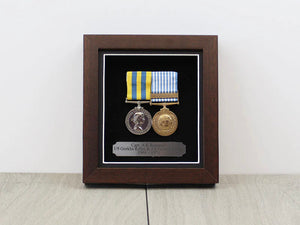
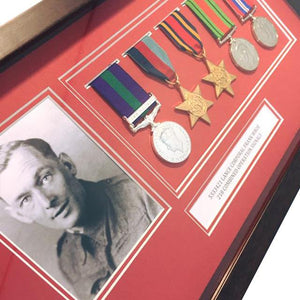
For framed displays, include a discreet provenance card rather than placing documents permanently behind a sealed frame. A concise card can identify the recipient, service branch, ships, campaigns and the source of the supporting record. The full research file should remain accessible outside the frame.
When considering a naval medal or group, ask what evidence supports the attribution, whether the naming is official, and whether the medals have remained together since issue. Request clear images of the rims and backs, not just the front of the medals. A reputable description will distinguish fact from opinion and identify replacements, copied clasps, later ribbons or privately assembled groups.
It is also sensible to ask whether paperwork accompanies the medal and whether the seller can provide prior auction details or collection history. Absence of paperwork does not make an award suspect. Many genuine medals survive without it. It simply means the buyer should place more weight on naming, entitlement and physical examination.
Be wary of certainty where the evidence is thin. Phrases such as “probably to” or “believed to have been worn by” may be honest, but they are not proof. Price a medal according to what is known, not the most appealing possible story.
A well-kept naval medal is a tangible record of service, but its story depends on the care taken around it. Preserve the names, papers and research with the same respect given to the award itself, and the connection between medal, sailor and service can endure for the next custodian.
Leave a comment