
Expert Support
Visit our Helpdesk
Visit our Helpdesk

A medal can carry a full service history in a small space. The right inscription confirms who received it, why it matters and how it should be remembered. This medal engraving guide explains how to approach new, replacement and commemorative medals with the accuracy and respect they deserve - without compromising an original award’s history or presentation.
The terms are often used interchangeably, but they do not always mean the same thing. Many British service medals were issued with official naming around the rim. Depending on the period and award, this may include a recipient’s service number, rank, initials, surname and regiment or service. The style, spacing and abbreviations form part of the medal’s character and, for collectors, its provenance.
Engraving usually refers to lettering added after manufacture. It may be requested for a privately purchased commemorative medal, a presentation award, a replacement or replica medal, or a separate plaque within a frame or display case. It can also refer to personalisation on the reverse of a medal where no official naming is expected.
That distinction matters. A historic medal with original naming should not be re-engraved simply to make worn letters easier to read. Altering original naming can reduce collector interest, obscure evidence and make an award harder to assess accurately in the future. Careful cleaning, conservation and a clear display label are often the better answer.
Engraving is particularly suitable when a medal has been made for presentation rather than issued by the Crown. It is also a practical option for commemorative awards, long-service presentations, sports medals, cadet awards and family keepsakes. For a replacement or replica service medal, the intended use makes a difference.
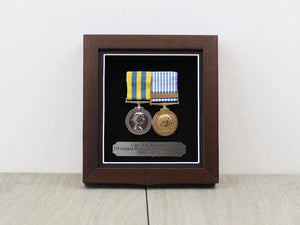
A replica intended for wear alongside a family display may benefit from clear, period-appropriate naming. A medal being used solely as a representative placeholder in a frame may be better paired with an engraved plaque that explains the recipient’s service. This preserves a clean distinction between the original award and a later presentation piece.
For officially issued British medals, always establish whether an entitlement exists before ordering a replacement. The wording on a replacement should be based on reliable records, not family recollection alone. A single incorrect initial, service number or rank can be difficult to correct once the work is complete.
The most effective engraving is concise. A medal has limited room, and too much text can look crowded or become difficult to read. For service-related medals, the usual identifying details are the recipient’s rank, initials, surname, service number and unit, where appropriate.
The precise format should follow the era and type of medal wherever possible. Older awards may use abbreviated ranks and regiment titles that differ from modern service conventions. Post-war medals can have different naming practices again. If you are seeking historical accuracy, do not assume that a current rank title or unit abbreviation is correct for a medal earned decades ago.
For private presentation medals, a name and date may be enough. A retirement award might include the recipient’s name, years of service and branch of service. A memorial medal may use a name, dates and a brief phrase chosen by the family. If the wording is longer than one short line, an engraved plate beneath the medal is often more dignified and far more legible.
Before submitting instructions, write the wording exactly as it should appear, including full stops, initials, capitals and spacing. “J. R. SMITH” is not the same instruction as “JOHN ROBERT SMITH”. Do not leave abbreviations, punctuation or line breaks to assumption where accuracy is important.
Good engraving is not simply a matter of fitting text into a space. Letter size, depth, alignment and finish should work with the medal rather than compete with its design. The lettering should be readable at normal viewing distance, while retaining enough margin from edges, portraits, crests and raised decoration.
Traditional block capitals are often the most suitable choice for military and ceremonial presentation. They are clear, formal and less likely to appear out of place beside a die-struck design. Script lettering can suit civilian commemorative awards, but it may be less practical for detailed service information or smaller surfaces.
The position of the inscription depends on the medal. Rim naming can look authentic on medals that historically carried it, but only where the medal has sufficient space and the work is appropriate to its purpose. Reverse engraving is common for presentation medals. A separate plate provides the greatest flexibility, especially when a family wishes to record a fuller story, campaign details or a dedication.
Ask to see the proposed layout if the wording is unusual, lengthy or particularly significant. A proof gives you the opportunity to check spelling and presentation before permanent work begins. It is much easier to amend a digital layout than an engraved medal.
The medal material and intended use should guide the engraving method. Mechanical engraving creates crisp, consistent lettering and is well suited to formal, repeatable text. Hand engraving can offer a more traditional character, though it depends on the design, available space and the finish required. Laser engraving may be appropriate for certain presentation items, but its appearance can differ from cut lettering on metal.
There is no single best method for every medal. A highly polished silver-coloured surface may show fine engraving beautifully, but it can also reveal scratches if handled carelessly. Antique-finished or bronzed medals may need lettering that complements the darker surface. For parade wear, durability and clarity are usually the priority. For a framed family heirloom, the quality of the overall presentation may matter more than deep lettering on the medal itself.
Original medals deserve a conservative approach. Dirt, tarnish and ribbon wear can be tempting to remove, but aggressive polishing or alteration may take away historic surface detail. A medal’s age is not a defect. In many cases, it is part of the evidence that makes the piece meaningful.
If original naming is faint, begin by recording it. Take high-resolution photographs in good natural light, noting any lettering that can be read. Compare the details with service documents, medal rolls, family papers or confirmed entitlement records. A professional can then advise whether gentle cleaning, stay-bright protection, remounting or framing is suitable.
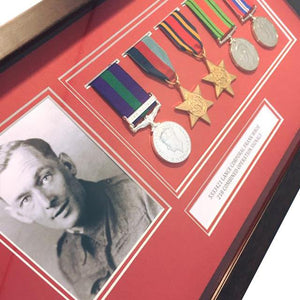
Avoid adding modern names, unofficial campaign details or memorial wording to an original issued medal. These additions can create confusion for future family members and collectors. A dedicated plaque in a frame provides the same personal context without changing the historic object.
This is especially relevant when medals have passed through several generations. The recipient’s story may be known within the family but absent from the medal itself. A properly worded display label can preserve that knowledge: full name, service, unit, conflict, dates and family connection. It is a respectful solution that can be updated if new research comes to light.
Engraving errors are permanent, so the checking stage should never be rushed. Confirm the recipient’s full name against official paperwork where available. Check the service number character by character. Verify the rank held at the relevant date, rather than using a later or retirement rank unless the medal is a private presentation piece.
For unit titles, use the historic form relevant to the award. Regimental amalgamations, renamed units and changes between Army, Royal Navy and Royal Air Force conventions can all affect the correct wording. Campaign dates also need care: the date of issue is not necessarily the period of service recognised by the medal.
Where records are incomplete, it is better to use a simple, confirmed inscription than to add uncertain detail. “In memory of Private A. Smith” may be more appropriate than an elaborate line containing an unverified battalion or service number. Accuracy is a form of respect.
Engraving is strongest when considered alongside the whole medal presentation. A correctly mounted medal set, clean ribbons, appropriate clasps and a well-proportioned frame all affect the final result. If medals are intended for wear, the engraving must remain discreet and compatible with the mounting style. If they are for display, a plaque can carry the detail while the medals remain visually uncluttered.
Empire Medals can help customers bring these elements together, from British-made and replica medals to specialist engraving, mounting, cleaning and bespoke framing. The aim is not simply to add text, but to create a presentation that remains accurate, durable and fitting for the recipient.
A careful inscription gives a medal a clear voice for the next generation. Take the time to verify every detail, choose a finish suited to its purpose and preserve original awards exactly as the history entrusted them to you.
Leave a comment