
Expert Support
Visit our Helpdesk
Visit our Helpdesk

A British medal mounting service review should begin with the standard of the finished bar, not simply its appearance in a photograph. Medals carry a record of service, family history and formal recognition. Whether they are being prepared for a parade, restored after years in a drawer or arranged as a family presentation, they must be mounted accurately, securely and with proper regard for the order in which they are worn.
Professional mounting is not a one-size-fits-all task. The right method depends on the medal entitlement, the number of awards, the intended use and, in some cases, the condition of original medals and ribbons. A good service will establish those details before any work begins.
The central test is simple: does the completed group look correct, sit properly when worn and remain stable over time? This calls for more than attaching medals to a bar. The mount must follow the recognised order of wear, use suitable ribbons, accommodate authorised clasps and present the awards in a way appropriate to their purpose.
A specialist service should be able to work with full-size and miniature medals, official and MoD Licensed Replica Medals, replacement ribbons and historical groups. It should also advise where a medal is missing, a ribbon has faded or a clasp needs to be represented. For inherited groups, that advice matters. It is easy to make a set look tidy while unintentionally altering the character or historical accuracy of the original awards.
Quality materials are equally important. British-made, die-struck replica medals and correctly woven ribbons give a group the weight, detail and finish expected for ceremonial wear. The mounting materials behind the medals should be neat and durable, without visible rough edges, loose stitching or gaps that allow medals to twist out of line.
Most customers will need to choose between court mounting and swing mounting. Both are established British styles, but they serve different preferences and practical requirements.
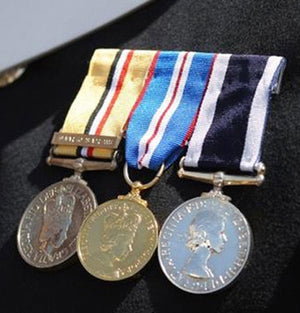
Court mounting fixes each medal to a covered backing board, usually with the ribbons arranged in a closely aligned row. The medals do not swing freely. This produces a clean, compact presentation and reduces movement when the group is worn. It is often the preferred choice for formal occasions, regular parade use and larger groups where free-hanging medals can become awkward or noisy.
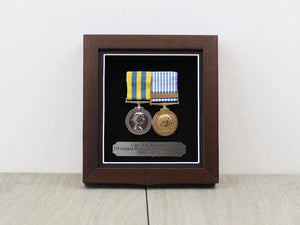
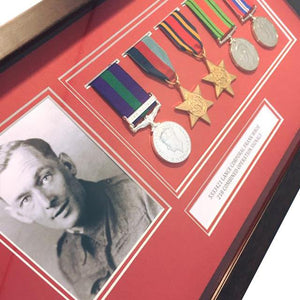
A well-court-mounted bar should hang squarely, with each medal at the correct height and its ribbon evenly tensioned. The reverse should be fully finished and fitted with a strong brooch pin. Court mounting is also a sensible option for presentation pieces that will be framed, although medals intended only for display may require a different approach to preserve their original components.
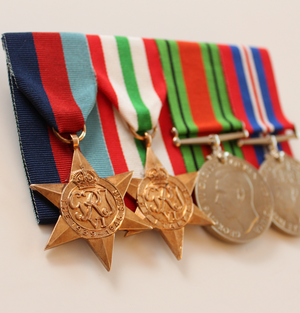
Swing mounting retains the traditional free-hanging arrangement. Each medal hangs from its own ribbon and moves independently, giving the group a more traditional appearance. This is often chosen by collectors, for smaller groups and by those who prefer the style associated with earlier service dress and original issue presentation.
The trade-off is movement. A swing-mounted group needs careful spacing so the medals do not overlap excessively or sit unevenly. It may also be less convenient for active parade wear, particularly where several medals or substantial clasps are involved. Neither method is universally better. The right choice is the one that meets the wearer’s requirements while respecting service custom and the medal group itself.
The most valuable part of professional mounting is the checking that happens before the needles, board and ribbon are used. Medals are generally worn in the recognised order of precedence, not in the order they were found in a box or acquired by a family. Campaign awards, long service medals, commemoratives, foreign awards and authorised clasps can all affect the final arrangement.
A reliable service will ask for clear information about the recipient, entitlement and intended use. If the group includes unofficial commemorative pieces, foreign decorations or privately purchased replacements, these should be identified separately. Some may be suitable for a display or commemorative bar but not for official wear. This distinction protects the dignity of genuine entitlement and avoids an avoidable error on parade.
The same care applies to ribbons. A ribbon that is the wrong shade, width or era can undermine an otherwise excellent mount. It is particularly relevant with older campaign medals, Second World War awards and long-service groups, where replacements of varying quality have circulated for decades. Authentic quality is not only about the medal itself. It is about the complete and correct presentation.
Before committing medals to any mounting service, assess the process rather than relying solely on a finished image. Clear communication and a willingness to clarify uncertainty are reassuring signs. You should know what will be mounted, which parts will be replaced if necessary and whether original ribbons or fittings will be retained.
Four practical checks help set expectations:
Medals do not always need to be cleaned before mounting. Natural age, toning and signs of service can be part of an original group’s history. Aggressive polishing may remove desirable surface character, damage detail or create an appearance that no longer matches the age of the awards. For collectors and families preserving a named group, conservative handling is often the sounder choice.
By contrast, replica sets and medals intended for current ceremonial wear may benefit from cleaning, new ribbons and a protective stay-bright coating. The purpose is different: the wearer needs a smart, durable bar that will stand up to regular use. A specialist should explain the options rather than treating every group alike.
Replacement medals should also be chosen carefully. A lost family award may call for a faithful replica, while an original named medal might be better left unaltered and represented separately for wear. In some cases, families choose a mounted replica set for ceremonies and keep the originals safely stored or framed. This balances respect for the originals with the practical need to wear a complete group.
Take clear photographs of the front and reverse of every medal before sending them away. Record any names, service numbers, dates, clasps or maker marks. This is good practice for insurance and provides a useful record for the family, particularly where the group has not previously been catalogued.
Keep medals together in their existing order, but do not assume that order is correct. Include written notes covering the recipient’s service, any known missing awards and the style of mounting required. If ribbons are to be replaced, say whether the old ribbons should be returned. Original ribbon fragments can have historical value even when they are no longer suitable for wear.
For a complete service, Empire Medals can bring mounting together with replacement medals, ribbons, engraving, cleaning and display options. That is particularly useful when a group needs careful preparation rather than a simple re-pin.
A properly mounted medal group should feel considered rather than merely assembled. Choose a service that checks the detail, explains the choices and treats every award with the respect its history deserves.
Leave a comment