
Expert Support
Visit our Helpdesk
Visit our Helpdesk

A single medal can record an act of courage, a long career, or a moment of service under exceptional pressure. This British gallantry awards identification guide helps families, collectors and serving personnel distinguish the principal British decorations by their purpose, design, ribbon and place within a medal group. Careful identification matters before a medal is replaced, mounted, engraved or framed.
A ribbon is a valuable first clue, but it should never be the only basis for identification. Several British awards use similar combinations of blue, crimson, white and red, while ribbons can fade, be cut for mounting, or be paired with the wrong medal after years in storage. Examine the medal itself first: its shape, metal, obverse design, reverse inscription, suspension and any named details.
Gallantry awards are made for courage in the face of danger. They are distinct from campaign medals, long-service awards and many honours for merit. A campaign medal records qualifying service in a particular operation or theatre, often with a clasp for a defined period or location. A gallantry decoration recognises an individual act, or acts, of bravery. It may therefore appear within a group alongside campaign medals from the same conflict.
Names, dates and service numbers can be particularly useful. Earlier medals were often officially impressed or engraved around the rim, although practice varies by award and period. Never clean a named medal aggressively to make an inscription easier to read. Abrasive polishing can remove original finish and damage the very evidence needed to establish provenance.
The Victoria Cross, or VC, is the United Kingdom's highest award for gallantry in the presence of the enemy. Its distinctive bronze cross pattée carries a crowned lion above the words “FOR VALOUR”. It is suspended from a plain crimson ribbon.
The VC is often recognised immediately, yet care is still needed. Its dark bronze appearance, compact form and plain ribbon set it apart from many other decorations, but replicas and commemorative pieces are common. A genuine historic VC requires specialist examination, including assessment of naming, provenance, dimensions and manufacture. It should not be judged from a photograph alone.
The bar on the ribbon denotes a subsequent award of the VC. Where a recipient has received more than one VC, a miniature replica of the cross may be worn on the ribbon bar.
The George Cross, or GC, is awarded for acts of the greatest heroism or of the most conspicuous courage in circumstances of extreme danger, generally away from direct combat with an enemy. It is a silver cross, bearing St George and the dragon at its centre, with “FOR GALLANTRY” around the medallion. Its ribbon is dark blue with a broad crimson stripe down the centre.
The distinction between the VC and GC is central to correct identification. The VC is specifically for gallantry in the presence of the enemy. The GC recognises comparable courage in other circumstances, including civilian bravery and hazardous service. Both rank at the highest level of British gallantry awards.
Some historical awards were later exchanged for the George Cross. Holders of the Empire Gallantry Medal and Albert Medal were given the option, and in certain cases the requirement, to exchange their original decorations. This can explain why family records mention an earlier award while the medal present is a George Cross.
Below the VC and GC are decorations whose names often indicate the service environment in which the gallantry was performed. Context is useful, but it is not a substitute for inspecting the decoration and confirming the official award record where possible.
The Conspicuous Gallantry Cross, or CGC, is a cross-shaped decoration introduced in 1993 for conspicuous gallantry in action. It replaced several earlier service-specific awards at a comparable level. It may be awarded across the armed forces and is particularly associated with operational service from the late twentieth century onwards.
The Distinguished Service Cross, or DSC, is associated with gallantry during active operations at sea. The Military Cross, or MC, recognises exemplary gallantry during active operations on land. The Air Force Cross, or AFC, recognises exemplary gallantry while flying, though the precise eligibility and circumstances have developed over time. Their names offer a practical starting point: naval, land and air service respectively.
This distinction is often helpful when examining a group. A soldier's group may include an MC with operational campaign medals, while a naval officer's group may include a DSC. However, careers are not always neatly confined to one environment, and attachments or joint operations can complicate assumptions. Service papers and citations remain the best supporting evidence.
The King's Gallantry Medal, or KGM, is a circular silver medal awarded for acts of exemplary bravery. It is the current name for the award previously known as the Queen's Gallantry Medal, or QGM. The change reflects the Sovereign, rather than the creation of a wholly different level of award.
A medal bearing the Queen's effigy and described in records as a QGM should be retained and identified as such. It is part of the recipient's original history. Modern KGM examples bear the current Sovereign's effigy. The ribbon is blue with a broad central crimson stripe and narrow white edging, making it important not to confuse it with the George Cross ribbon.
The George Medal, or GM, is another significant award for bravery in dangerous circumstances, commonly associated with civil defence, bomb disposal, rescue and public service. It is a circular silver medal, rather than a cross. Its ribbon is crimson with narrow blue stripes near each edge. The GM may be encountered in wartime civil-defence groups and in medals awarded to police, fire and rescue personnel, seafarers and civilians.
Historical groups can also include awards such as the Sea Gallantry Medal, which has a long maritime rescue tradition. Such medals require period-specific research. Their wording, ribbon and class can differ significantly across their history.
A decoration is not always the full story. A bar or clasp can indicate a further award, while an emblem on the ribbon may indicate a Mention in Despatches or another distinction. Devices should be examined closely, as their form and position are governed by established conventions.
A Mention in Despatches is not a medal in its own right. It is recognised by an oak leaf emblem worn on the ribbon of an appropriate campaign medal or, where no campaign medal is authorised, on a specified ribbon. A single oak leaf can be easy to overlook in a framed group, but it carries real significance and should not be omitted when replicas are prepared or medals are remounted.
Post-nominal letters provide another useful check. VC, GC, CGC, DSC, MC, AFC, GM and KGM may appear in service records, obituary notices, London Gazette entries and family papers. They are strong evidence when they match the medal in hand, but typographical errors occur. Treat them as one part of the identification process rather than final proof.
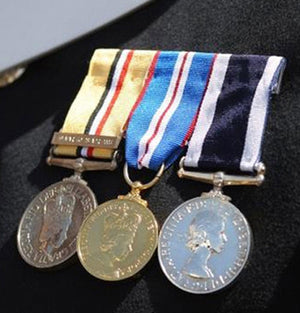
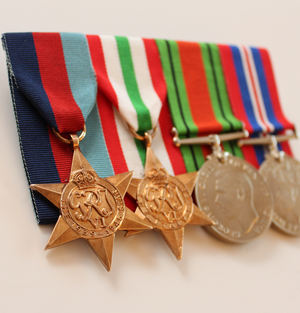
Medal groups should be read from left to right as worn by the recipient, with the senior award placed first. The order of wear is formal and must be respected when preparing full-size replicas, miniatures or court-mounted sets. A gallantry award may be followed by campaign medals, jubilee or coronation medals, and long-service decorations.
Before commissioning replacements, record every detail: clear photographs of both sides, ribbon widths and colours, clasps, devices, naming, mounting style and any accompanying documents. Photograph the medals in their existing order before removing them from a bar. This is especially valuable where a group has been mounted decades ago and family knowledge is incomplete.
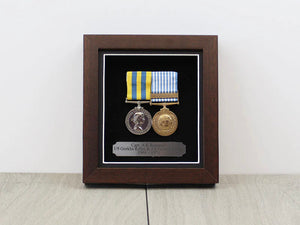
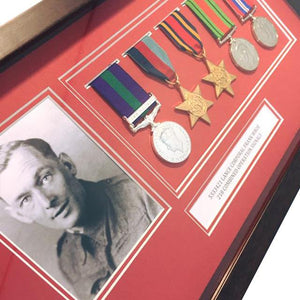
It also pays to separate preservation from restoration. A loose original ribbon may need careful replacement for safe wear, while a historically important original group may be better preserved in its current condition and displayed in a protective frame. Stay-bright coating, cleaning and remounting can be appropriate for medals intended for ceremonial use, but the correct treatment depends on whether the priority is parade wear, long-term preservation or family display.
For complex groups, Empire Medals can assist with accurate replica preparation, medal mounting and presentation work based on the recorded awards and proper order of wear. Quality should be judged by faithful design, correct ribbon specification and craftsmanship that respects the original recipient.
A gallantry medal is more than an object of silver, bronze or ribbon. Take the time to establish what it is, whom it belonged to and how it should be presented. That care protects both the medal and the courage it represents.
Leave a comment