
Expert Support
Visit our Helpdesk
Visit our Helpdesk

A medal group on a blazer can tell half a century of service in a glance. It can also raise practical questions very quickly - what was awarded, in what order should it be worn, and how do you replace or preserve it without losing accuracy? This British campaign medals guide is written for veterans, families and collectors who want clear, correct answers rather than guesswork.
British campaign medals are not simply decorative awards. They mark qualifying service connected to a defined campaign, operational theatre, or period of duty authorised by the Crown and administered under formal regulations. That distinction matters because campaign medals sit within a wider honours and awards framework that also includes gallantry medals, long service awards, coronation and jubilee medals, and efficiency decorations.
For most buyers and collectors, the first point of confusion is that not every medal earned in service is a campaign medal, and not every campaign medal was issued under the same conditions. Some require a set number of days in theatre. Some depend on operational risk, geographic boundaries, or dates of service. Others are recognised through clasps rather than a separate medal.
That is why precision matters when replacing a lost medal, ordering a replica, or building a family display. The medal itself is only part of the story. Naming, ribbon, clasp entitlement, and wear order all need to match the service record.
The broadest way to understand British campaign medals is by era and by type of operational service. Pre-First World War awards differ significantly from the large-scale issue patterns seen in the First and Second World Wars. Post-war medals then move into national campaign awards, General Service Medals, and multinational awards such as NATO and United Nations medals.
Earlier British campaign medals often relate to specific colonial, imperial, and expeditionary actions. These are highly collectible and often identified by a combination of medal type and clasp. In many cases, the clasp is essential. Two recipients may hold the same medal but for entirely different theatres, distinguished only by the bar on the ribbon suspender.
Because originals from these periods can be scarce, condition and authenticity become especially important. Collectors will usually look closely at rim naming, die characteristics, and period correctness. Families, by contrast, are often more concerned with producing a respectful display or obtaining a high-quality replica for wear while protecting the original.
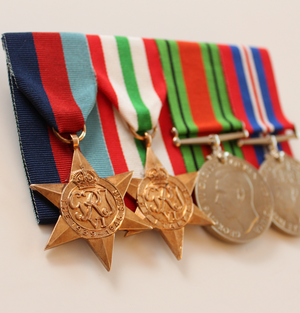
The two World Wars introduced medal groups that are among the most recognised in British military history. The 1914 Star, 1914-15 Star, British War Medal and Victory Medal formed classic First World War combinations, while the Second World War brought campaign stars, the Defence Medal and the War Medal 1939-45.
These groups often appear straightforward until entitlement is checked properly. Service branch, theatre, dates, and operational criteria all affect what should be present. It is common for descendants to inherit a group and assume something is missing, when in fact the entitlement is correct. The reverse can also happen, especially where ribbons have been rearranged over time or copied inaccurately in older family displays.
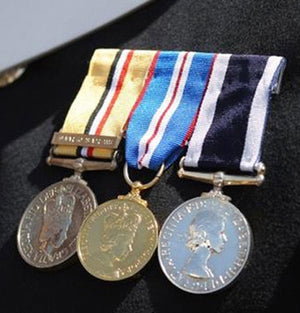
Post-1945 British campaign recognition becomes more varied. General Service Medals and Operational Service Medals often cover multiple theatres through clasps, while specific medals were authorised for conflicts including Korea, the Falklands, the Gulf, Iraq and Afghanistan. Alongside these sit NATO and UN medals awarded under different authorities but worn within British regulations.
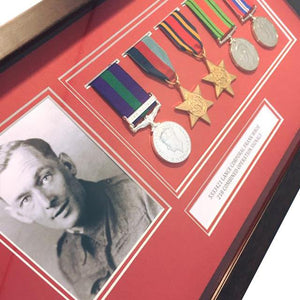
This is where practical buying decisions matter most. A veteran may need a parade-ready replacement group. A family may need a mounted replica set for remembrance purposes. A collector may want a historically accurate example for a particular campaign. In each case, the correct issue style, ribbon, clasp and finish should be confirmed before anything is mounted or framed.
A proper identification starts with four things - the medal design, the ribbon, any clasp, and the named or unnamed edge. If you have paperwork, that helps, but many people begin with only a photograph or a small box of inherited medals.
Ribbon colours are often the quickest clue, though not always the safest one. Some ribbons are instantly recognisable, while others are similar enough to cause mistakes if viewed from memory alone. Clasps can narrow the field dramatically, particularly for General Service and campaign-specific awards. Naming is another key factor, especially on original issue medals, but naming styles changed over time and not every medal was officially named.
If a group includes miniatures, treat them as a guide rather than proof. Miniature groups are often privately assembled and can contain errors in order, clasp details or even medal selection. The same caution applies to old dealer descriptions and handwritten notes from previous owners.
One of the most frequent issues in any British campaign medals guide is order of wear. In British practice, medals are worn according to the official order of wear, not personal preference or family tradition. Campaign medals usually sit alongside other awards in a sequence governed by the date and status of the award category.
That sounds simple, but medal groups become more complicated once coronation medals, long service awards, efficiency decorations, NATO medals or foreign awards are involved. An incorrect order is more than a cosmetic detail. For veterans and ceremonial wearers, it affects standards of dress. For framed groups and family presentations, it affects historical accuracy.
Court mounting and swing mounting also change how a group presents. Neither is inherently right in every case. It depends on service custom, personal preference, and intended use. A group for regular wear on parade needs different handling from a display intended for a study wall or family memorial cabinet.
For many customers, the real question is not whether a medal existed but what form they should buy. Originals have collector and family value, but they are not always suitable for wear. They can be costly, difficult to source, or too important to risk on ceremonial occasions.
That is where quality replicas serve a clear purpose. A properly produced replica, especially where it is MoD licensed for applicable issues and struck to a high standard, allows a veteran or family member to wear a group confidently while preserving the original. The key is to avoid generic copies that look acceptable at a distance but fail on dimensions, ribbon shade, suspender detail or clasp quality.
If you are replacing a lost medal group, accuracy matters more than speed. It is worth confirming entitlement, service branch details, and whether full-size or miniature medals are required. The right set should not only look correct in a case. It should also be fit for wear, mounting and long-term keeping.
A medal is only as presentable as the finishing work behind it. Poor mounting can distort a group, hide ribbon detail, or place medals in the wrong sequence. Weak brooch fittings and thin ribbon work may not hold up to regular wear. For that reason, professional mounting remains one of the most valuable services attached to medal buying.
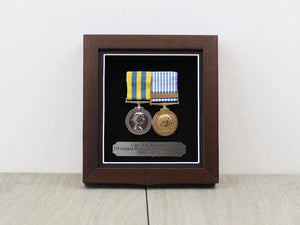
Engraving needs similar care. Some medals should not be engraved if that would conflict with period correctness or official issue style. Others may be presented in a display with an engraved plate rather than altered directly. It depends on whether the aim is ceremonial use, memorial presentation, or a collector-standard arrangement.
Preservation is often overlooked until damage has already set in. Silver darkens, ribbon fibres fade, and old mounting boards can stain fabric over time. Cleaning must be sympathetic. Over-polishing can reduce character and, in collector terms, value. A sensible approach is to stabilise, protect and display rather than trying to make every group look newly issued.
The safest approach is always specialist rather than generalist. British campaign medals are one of those areas where small details make all the difference. Correct clasp combinations, proper ribbon shades, die-struck quality, and sound mounting standards are not extras. They are the basis of a medal group that can be worn, displayed or handed on with confidence.
Empire Medals serves that need by combining specialist medal knowledge with mounting, engraving and presentation services under one roof. For customers, that reduces the risk of assembling a group in stages and ending up with avoidable inconsistencies.
Whether you are replacing a grandfather's wartime medals, preparing a modern group for parade wear, or building a collection around a specific campaign, careful choices tend to reward themselves. A well-made and correctly presented medal group does more than look right. It respects the service behind it, which is where any worthwhile guide should begin and end.
Leave a comment