
Expert Support
Visit our Helpdesk
Visit our Helpdesk

A medal group can be historically correct, beautifully struck and in excellent condition, yet still look wrong if it is mounted poorly. That is usually where problems begin - uneven spacing, ribbons cut to the wrong depth, medals swinging awkwardly, or an order of wear that does not match the recipient's entitlement. If you want to understand how to mount medals correctly, the first step is to treat mounting as both a craft and a matter of protocol.
Mounting is not simply attaching medals to a bar. It is the process of arranging them in the proper order, setting the ribbons to the right length, and securing the group so it presents neatly whether it is worn on parade, placed in a frame or kept as a family heirloom. The correct method depends on use. A serving person preparing medals for formal wear may need a compact court-mounted group, while a collector or family member may prefer swing mounting for period accuracy in a display.
That distinction matters. There is no single method that suits every medal group, every era or every purpose. What is correct for ceremonial wear may not be the best choice for a Victorian campaign pair in a presentation case.
Before any ribbon is cut or any pin is fixed, confirm the order of wear. This is the foundation of proper mounting. British medals are worn in an established sequence based on the rules governing campaign medals, service decorations, coronation and jubilee issues, efficiency awards and foreign awards where approved.
If the order is wrong, the mounting is wrong, however tidy the finish may be. Families assembling a relative's medals and collectors rebuilding groups often run into difficulty here, especially where long service awards, unofficial commemoratives or duplicate replacements are involved. A mixed group can appear straightforward until small details alter the sequence.
As a general rule, medals are mounted from the wearer's right to left as they would appear when worn, which means they are usually viewed from left to right by the observer. Full-size and miniature medals should never be mixed in the same mounted group. Replica medals should also be matched carefully in style and finish so the set presents consistently.
Once the entitlement and order are settled, the next question is mounting style. In British practice, the two main forms are swing mounting and court mounting.
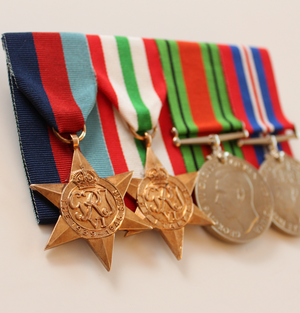
Swing-mounted medals hang freely from the ribbon and move independently. This is a traditional style and is often preferred for historically faithful presentations, particularly with older groups. It preserves more of the natural appearance of the medals and can suit collectors who want a period look.
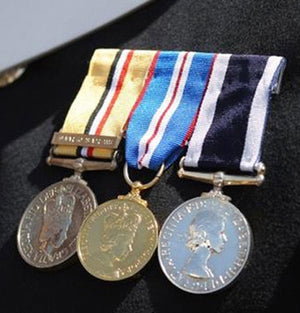
Court-mounted medals are fixed onto a rigid backing so the medals lie neatly in position and do not swing. This gives a flatter, more controlled finish and is widely preferred for parade wear and modern ceremonial presentation. It also reduces movement, which can lessen ribbon wear over time.
Neither style is automatically better in every case. Court mounting gives a sharper and more practical result for wear, but swing mounting can be more appropriate where historical authenticity of display is the priority. The right answer depends on whether the medals are intended for active use, framing or collection.
Medals should be checked carefully before they are mounted. Look at the suspension, the ribbon, any naming on the rim and the surface finish. If a medal is dirty, toned or lightly tarnished, resist the temptation to polish aggressively. Over-cleaning can damage the original finish and reduce historical value, especially on older issues.
It is also worth checking whether the ribbons are correct in colour, width and weave. Faded or incorrect ribbons can spoil an otherwise accurate group. On a large medal bar, one poor replacement ribbon tends to stand out immediately.
Where medals are being remounted, old stitching, bent bars or brittle ribbon backing should be removed carefully. If the group includes named medals, this is a good stage to confirm the details once more before everything is fixed in place.
Ribbon work is where much of the visible skill lies. Medals should hang at a consistent depth, and the amount of overlap between medals needs to be judged according to the size of the group. With one or two medals, there may be little or no overlap. Larger groups generally require graduated overlap so that each ribbon is visible and the medals sit evenly without excessive width.
There is a practical balance to strike. Too little overlap produces a very wide and awkward group. Too much overlap hides the medals and can make the whole set appear cramped. The aim is a clean line across the top with enough of each medal and ribbon showing to identify the group properly.
For miniature medals, the same principles apply, but proportions must be adjusted carefully. A miniature group that mirrors the spacing of a full-size bar often looks heavy and poorly scaled.
The best mounting work respects the medal as an object. Original suspensions should not be forced, bent or altered unnecessarily. Stitching and backing should hold the medals securely without putting strain on the ribbon or the suspender.
A proper mounting bar should support the full weight of the group. This becomes especially important with heavier campaign medals, gallantry awards or long medal runs. Weak fittings, poor backing materials and careless adhesive use are common causes of later damage.
Adhesives deserve a particular warning. Glue is sometimes used in low-standard mounting work to hold ribbon folds or fix medals into place quickly. It may look acceptable at first, but it can stain ribbon, fail over time and make future restoration difficult. Traditional hand-finishing and secure stitching remain the better standard where quality and preservation matter.
Mounted medals should sit correctly on the left breast when worn, attached firmly enough to remain level but not so tightly that the cloth pulls. If the group is too deep, too loose or badly balanced, it will not sit properly on a jacket or tunic.
This is one reason experienced wearers often choose professional mounting for formal occasions. A medal bar that looks fine on a table may behave quite differently when pinned to a mess dress jacket, blazer or service uniform. Court mounting usually gives more stability here, although the garment and occasion should still be considered.
For right-breast wear, such as relatives wearing a deceased family member's medals in remembrance, the medals should still be mounted accurately and respectfully. The side of wear changes, but the order and finish should not be improvised.
The most frequent errors are straightforward but noticeable. Incorrect order of wear is the most serious. After that come poor ribbon matching, uneven heights, excessive overlap and bars that are either too flimsy or too wide for comfortable wear.
Another common problem is mixing original medals with low-grade copies that do not match in finish or thickness. If a replacement is needed, it should be selected carefully so the group remains coherent. The same applies to clasps, rosettes and emblems, which must correspond exactly to entitlement and period style.
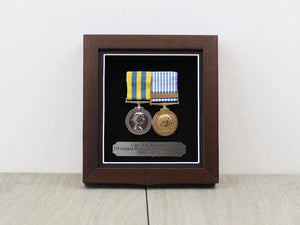
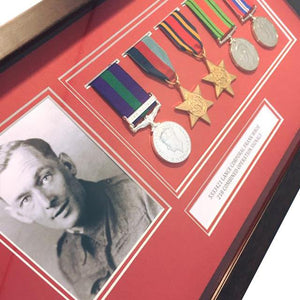
Display mounting can go wrong in different ways. Medals are sometimes fixed so tightly into a frame that the ribbon buckles, or arranged decoratively rather than correctly. A display should still respect order, spacing and the character of the group. Presentation matters, but not at the expense of accuracy.
Some single medals and simple pairs can be mounted successfully by a careful owner with the right materials and a sound understanding of order and finish. Larger groups, valuable originals and anything intended for parade wear call for more caution.
Professional mounting is usually worth considering when the medals are named, historically significant or emotionally important. It is also the safer route where there is uncertainty over order of wear, ribbon specification or whether swing or court mounting is more appropriate. Specialist finishers can also coordinate related work such as ribbon replacement, cleaning, engraving and framing so the whole presentation is handled consistently.
For many customers, that combination of accuracy and craftsmanship is the point. A medal group is not just an accessory. It may represent service across decades, a family history, or a carefully researched collection that deserves a proper standard of finishing.
Correct mounting gives medals the dignity they are meant to carry. If there is any doubt, it is better to pause, verify the entitlement and have the work done properly than to rush a result that never quite sits right.
Leave a comment