
Expert Support
Visit our Helpdesk
Visit our Helpdesk

A ribbon bar may be compact, but it carries the record of service, qualification and recognition behind every full-size medal. Choosing the best ribbon bars for uniforms is therefore not simply a matter of matching colours. The bar must reflect genuine entitlement, follow the correct order of wear and suit the uniform or occasion for which it is intended.
For serving personnel, veterans and families preserving a service record, accuracy matters. A well-made ribbon bar gives a smart, regulation-conscious appearance in daily dress and keeps the significance of the awards clear without wearing medals in full.
The best ribbon bar is the one that is correct for the wearer. It should reproduce each entitled medal ribbon faithfully, be assembled in the appropriate order of precedence and be made to a standard that remains neat through regular wear. Low price alone is rarely a useful guide. Poorly printed ribbon, uneven spacing or an incorrect arrangement can undermine an otherwise immaculate uniform.
A quality bar uses properly woven ribbon with clear colour definition. This is particularly important where distinctions are subtle: different NATO and United Nations awards, long-service medals, Jubilee and Coronation medals, and campaign awards can include similar blues, reds, whites or stripes. The ribbon must be identifiable at a glance, not merely approximately similar.
Construction also affects appearance. Ribbon bars are generally supplied as a single mounted unit, with the ribbons cut, aligned and secured to a backing. The finished bar should sit level, retain its shape and fasten securely to the uniform. It should not curl at the edges, gap between ribbons or look bulky beneath a jacket.
Before ordering a bar, establish exactly which awards the wearer is entitled to display. This means checking the formal medal record, certificates, service papers or other authoritative documentation. Family-held medal groups can be especially complicated where awards were issued many decades ago, replacements have been obtained, or several relatives served.
Do not add a ribbon because a relative served in a campaign, because a medal appears in a photograph, or because the colours seem familiar. Entitlement is personal. For a commemorative event, a family display or a collector’s presentation, a bar may be created to represent a historical group, but it should not be confused with a ribbon bar authorised for uniform wear.
There are also important distinctions between official awards, foreign awards, commemorative medals and organisation-specific decorations. Whether an item may be worn, and where, depends on the service, award status and current dress regulations. If there is uncertainty, verify the record before committing to a finished bar. Correcting an assembled ribbon bar later is possible, but beginning with an accurate list prevents avoidable expense and delay.
Award names are more useful than descriptions such as “the Afghanistan one” or “the long-service medal”. Campaigns may involve more than one qualifying award, while clasps and different issue periods can change the exact entitlement. Record the full title of each medal and, where known, the date or theatre of service.
Photographs are valuable supporting evidence, especially when the original medals are unavailable. However, images can distort ribbon colours and do not always show the full group clearly. Treat them as a starting point rather than final proof.
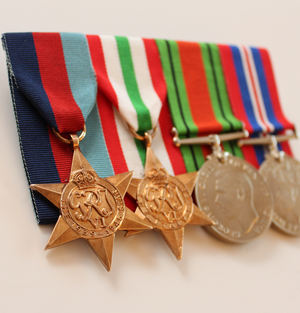
Ribbons are not arranged by personal preference, date received or visual balance. British orders, decorations and medals follow an established order of wear. Within a mounted ribbon bar, the most senior award is placed in the appropriate position, followed by the remaining awards in sequence.
This is the detail that separates a credible, parade-ready bar from a decorative approximation. It also explains why two people who served on the same deployment may not wear identical bars. One may hold earlier campaign, gallantry, long-service or Coronation recognition that takes precedence over later awards.
Foreign and Commonwealth awards require particular care. Their position and authorisation can differ from British honours, and some awards may require formal permission before they are worn on uniform. United Nations and NATO medals also have specific conventions. When in doubt, seek advice based on the wearer’s service branch and the current relevant dress guidance rather than relying on an online image.
A ribbon bar for routine service dress has different demands from one intended for a ceremonial occasion, a veterans’ association parade or occasional remembrance events. The underlying rules of entitlement and precedence remain the same, but the practical choice of backing, fastening and finish should suit how often the bar will be worn.
For frequent use, choose a firmly constructed bar with secure attachment and durable ribbon. A bar that is handled, transported and worn regularly needs to stay square. For occasional ceremonial wear, a carefully finished bar still matters, but preserving its condition between events becomes equally important.
The dimensions and placement must suit the relevant uniform. Do not assume that a ribbon bar made for one organisation or style of dress can be transferred directly to another. Service rules may differ in the permitted number of ribbons across a row, the use of multiple rows, spacing and positioning on the breast. A bar should always be checked against the dress instructions that apply to the wearer.
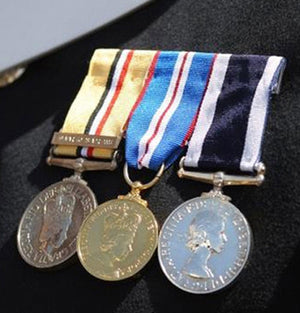
These items complement one another but are not interchangeable. Full-size medals are generally worn for formal ceremonial occasions where medals are prescribed. Miniatures are used with evening dress and specified mess dress arrangements. Ribbon bars are the compact everyday representation of awards, most often seen on service dress or other authorised forms of uniform.
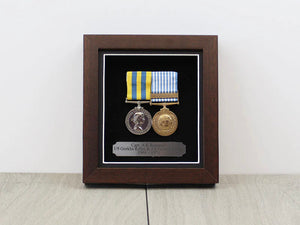
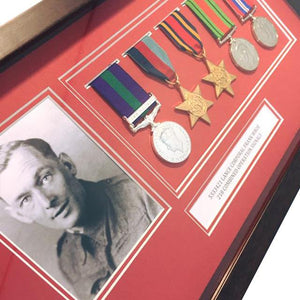
For families building a complete presentation, it is often worthwhile to consider all three formats together. A professionally mounted medal group, correctly assembled ribbon bar and a framed display can preserve a coherent record for both parade use and future generations. Empire Medals can assist with specialist medal mounting and presentation requirements where accuracy and finish are required.
Some award distinctions do not alter the ribbon bar, while others do. A clasp to a campaign medal, for example, may be represented by a small emblem on the corresponding ribbon bar where authorised. An oak leaf emblem for a Mention in Despatches, a rosette or other approved device can be equally significant. Leaving one off may make the bar incomplete; adding one incorrectly is no better.
The number of rows also deserves attention. A larger group cannot simply be compressed to fit a preferred layout. The applicable dress instructions determine the arrangement, and the completed rows should look balanced without sacrificing the proper sequence. Where a wearer has an extensive group, professional assembly is the sensible choice.
Avoid mixing loose ribbon strips with a finished bar unless you are certain of the required construction. Individual lengths are useful for repairs, tailoring and some specialist needs, but they do not offer the consistency, alignment or security of a properly assembled unit.
Ribbon bars benefit from simple, regular care. Keep them dry, away from direct sunlight and protected from crushing in a pocket, kit bag or drawer. Dust can usually be removed gently with a soft brush. Avoid harsh cleaning products, adhesive repairs and excessive heat, all of which can mark or distort the ribbon.
Before a parade or formal engagement, inspect the bar under good light. Check that it is level, free from loose threads and fixed securely. Compare it against the medal record if any awards or devices have been added since it was last worn. This small check is particularly worthwhile before a major service occasion, regimental event or family commemoration.
A correctly made ribbon bar does more than complete a uniform. It presents a service history with the restraint and precision that military tradition requires. Take the time to confirm the entitlement, order and finish, and the result will be something the wearer can display with confidence and proper pride.
Leave a comment