
Expert Support
Visit our Helpdesk
Visit our Helpdesk

A campaign medal in a drawer, a parade group needing replacement, a family set prepared for framing - each calls for a different decision. When comparing replica medals vs original medals, the right choice is rarely about price alone. It comes down to purpose, provenance, wearability, and the level of historical integrity required.
For some buyers, an original medal is the only proper option. For others, a licenced replica is the more responsible and practical choice, especially when the aim is display, remembrance, or parade wear without risking an irreplaceable piece. Understanding the distinction matters, particularly with British military and civilian medals, where accuracy and context are not optional extras.
An original medal is a period-issued or officially awarded piece. It has direct historical connection to the recipient, campaign, or service record. In many cases, that connection is what gives the medal its greatest significance. The medal is not simply the correct design - it is the medal, or one of its contemporaneous issued examples.
A replica medal is a reproduction made to match the appearance of the original. Quality varies widely in the market, which is why licencing and manufacture matter. A properly made British replica medal should reflect the correct finish, dimensions, suspender style, ribbon and overall character of the original award. For many modern buyers, especially veterans replacing lost medals for wear or families creating display sets, a well-made licenced replica is the sensible route.
The crucial point is this: a replica is not trying to replace the historical record. It is serving a different need.
If you are collecting for provenance, historical research, or long-term value, originals remain the benchmark. An original medal group can reveal service history, unit movement, campaign participation and, when named, the individual story of the recipient. That is why collectors place such importance on naming, impressed details, issue style and confirmed entitlement.
Original medals also matter where family inheritance is concerned. If a medal has come down through the family, its value is usually emotional before it is financial. Surface wear, age toning and minor marks are often part of that history. Cleaning or replacing such a medal without care can diminish what makes it important.
There is also the question of rarity. Some campaign medals, gallantry awards, and named groups are scarce enough that no serious collector would consider a replica as a substitute. A copy may show what the medal looked like, but it cannot carry the same documentary or historical weight.
That said, originals are not always the right choice for active wear. A full-size group worn on parade, at commemorative services, or on repeated public occasions is exposed to knocks, weather and loss. If the original is rare, named or deeply personal, wearing it regularly may be a risk not worth taking.
Replica medals are often the correct answer where the aim is respectful presentation rather than collecting. Veterans who need a replacement for wear, next of kin assembling a display, reenactors seeking visual accuracy, and families rebuilding a lost group may all be better served by a quality replica.
This is especially true where the original medal is unavailable, prohibitively expensive, or already preserved elsewhere. A replica allows the medal to be seen, mounted and worn in the right order without placing a genuine period piece under unnecessary strain.
There is also a practical advantage in consistency. When a court-mounted set is being prepared, or when miniatures are required to match a full-size group, modern licenced replicas can offer a clean, uniform finish suited to ceremonial presentation. In some cases, that makes them more useful than a mixed group of worn originals and later replacements.
For many customers, the strongest case for a replica is simple: it allows the story to remain visible.
This is where replica medals vs original medals becomes most clear. Original medals may hold collector value because they carry provenance. That value rises or falls based on condition, rarity, naming, entitlement and historical interest. A single unnamed campaign medal may have modest value, while a named gallantry group with documented service history may be of considerable importance.
Replica medals do not have that collector status in the same sense. Their value lies in quality of manufacture, accuracy and suitability for purpose. They are bought to represent an award correctly, not to function as original artefacts in the market.
That difference matters when buying. If a seller presents a replica in a way that blurs the line between copy and original, caution is warranted. Buyers should know exactly what they are purchasing, particularly when spending on historic awards. Straightforward description, correct attribution and proper identification are basic standards in this field.
Not all replicas deserve the same confidence. Poor examples often have weak detail, incorrect ribbons, wrong metals, bad suspender fittings or a finish that looks obviously modern and inaccurate. These issues matter more than many buyers first assume. A medal may be only slightly wrong in shape or ribbon width, but to anyone familiar with British honours and campaign awards, the error is immediately visible.
A dependable replica should be properly specified and, where applicable, MoD licenced. British manufacture and die-struck production are also strong indicators of quality. These details are not marketing embellishments. They are part of ensuring that the finished medal looks right in hand, wears properly, and sits correctly within a mounted group.
This is one reason specialist retailers remain important. Buyers are not simply purchasing metal and ribbon. They are relying on expertise in order of wear, campaign eligibility, clasp combinations, miniature matching and presentation standards.
The choice between original and replica often becomes clearer once mounting and display are considered. An original medal loose in a box may be historically significant, but if the intention is to create a parade-ready court-mounted group, preservation concerns come into play. Stitching, backing, alignment and repeated use can all affect the condition of older pieces.
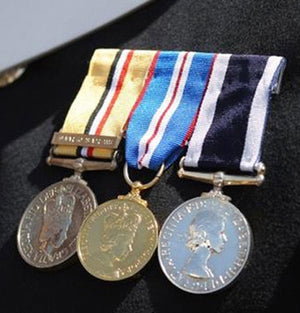
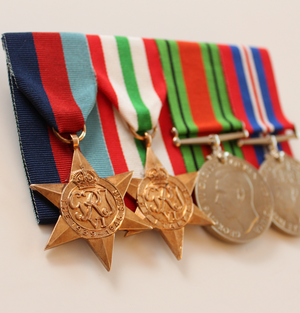
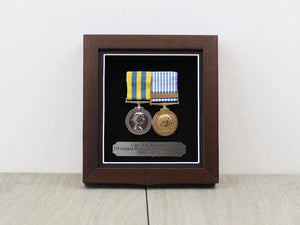
Replica medals are often better suited to active presentation. They can be court mounted, swing mounted, framed or engraved as part of a broader commemorative set without the same anxiety attached to handling an irreplaceable original. Miniatures present a similar case. For mess dress, dinners and formal occasions, a well-made miniature set offers practical wear while originals remain safely stored.
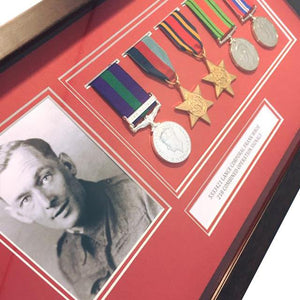
Families assembling remembrance displays also face this choice. If the original medals are fragile, incomplete, or too valuable to expose, replicas can be framed alongside photographs, service records and nameplates to create a respectful and durable display. In that setting, accuracy and craftsmanship matter as much as the medal itself.
British medal buying is not only a matter of taste. There are legal and ethical boundaries. Certain gallantry awards and decorations require particular care in sale, display and representation. Buyers should be clear on what they may wear, what they may collect, and what should be represented as replica rather than original.
There is also the ethical question of intent. Wearing medals to which one has no entitlement is very different from wearing family medals on the right side in remembrance, or purchasing replicas to complete a display. Context matters. So does honesty.
For collectors and families alike, the safest approach is clarity. Know whether the medal is original or replica. Know why you are buying it. Know how it will be worn, stored or displayed.
If you want a medal for research, collection, investment or family preservation, an original is usually the right choice, provided provenance and condition are sound. If you need a medal for parade wear, ceremonial replacement, restoration of a group, or a smart presentation piece, a licenced replica is often the more sensible purchase.
Some buyers need both. It is common to preserve original medals in secure storage while using replicas for wear or framed presentation. That approach respects the historical object without hiding the service it represents.
For that reason, the decision is not always replica or original in absolute terms. It is often original for custody, replica for use.
Specialist support makes a difference here. A retailer such as Empire Medals can help buyers source the correct medal, ribbon, clasp and mounting style for the job at hand, whether the priority is preservation, parade wear or family display.
A medal is never just an object once it is tied to service. The right choice is the one that protects that meaning, presents it properly, and treats the record with the respect it deserves.
Leave a comment