
Expert Support
Visit our Helpdesk
Visit our Helpdesk

A medal group can tell a lifetime of service at a glance, but only if it is worn in the correct order. The order of wear medals is not a matter of personal preference or visual balance. It follows established British rules of precedence, and getting it right shows respect for the award, the recipient and the occasion.
For veterans, serving personnel, families and collectors, this is often where uncertainty begins. A replacement medal may have been added years later. A family group may include both campaign and commemorative pieces. Civilian gallantry awards can sit alongside military service medals, but not always in the way people assume. The details matter, especially when medals are being court mounted, swing mounted, framed or prepared for parade wear.
In British practice, the order of wear medals refers to the official sequence in which decorations, campaign medals and other authorised awards are mounted and worn. The position of each medal is determined by precedence, not by date of issue, family importance or which service the recipient valued most.
As a rule, higher honours and decorations come before campaign and service medals. Coronation and Jubilee medals fall within their own recognised place. Long service and efficiency awards follow in the proper sequence. Foreign awards, where officially approved for wear, usually come after British awards.
This is why a medal group that looks tidy can still be wrong. A neatly mounted row is only correct if the precedence is correct first.
For most British medal groups, the broad sequence begins with gallantry and distinguished service decorations, then campaign medals, then coronation and jubilee awards, followed by long service and good conduct medals. Efficiency decorations and reserve awards have their own place, and authorised foreign awards come later.
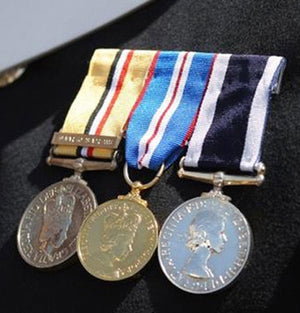
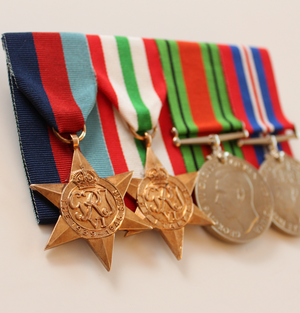
That broad outline helps, but real medal groups are rarely that simple. A First World War trio sits in a recognised sequence. A post-war group with GSM, Northern Ireland, Iraq, Afghanistan, Jubilee and Long Service requires much more care. Add clasps, miniatures or a mixture of military and civilian awards, and the need for accurate checking becomes obvious.
Where recipients have multiple honours from different periods, the official order can produce combinations that surprise families. A medal earned earlier in life may sit after one awarded later. That is normal. Precedence outranks chronology.
Decorations for gallantry, distinguished conduct or meritorious service generally come first. This includes many of the best-known British honours worn as medals. Their place reflects status within the honours system rather than active service dates.
Campaign medals then follow in their recognised order. In a military group, these often form the central visual record of operational service, but they do not take precedence over formal decorations.
Long service and good conduct medals are worn after campaign medals and before certain later categories, depending on the exact awards involved. Jubilee, Coronation and Durbar medals also have defined positions, and mistakes here are common in family-mounted groups assembled many years after issue.
Commemorative medals are a separate matter. Many unofficial commemoratives are collectable and meaningful to families, but they are not part of the official order for wear on uniform. They may be suitable for display, but not for formal wear where regulations apply.
The most frequent error is assuming medals should be mounted in the order they were received. That is understandable, but incorrect. Another is placing miniatures in a different sequence from the full-size set. Miniatures should mirror the same precedence.
Foreign and Commonwealth awards also cause confusion. Some are approved for wear, some are not, and approval can depend on specific rules and dates. A medal being genuine does not automatically mean it is authorised for wear in a British group.
A further issue arises with replacement medals. Families sometimes rebuild a group around a photograph, only to discover the original mounting was incomplete or out of order. In those cases, copying the old layout is not always the right answer.
There is also the question of unnamed versus officially impressed medals. That does not change precedence, but it can affect identification and confidence when reconstructing a group. If there is uncertainty over entitlement or sequence, it is worth checking before anything is mounted permanently.
British medals are normally worn on the left breast. That applies to the recipient wearing their own full-size medals. The left side position represents awards personally conferred or earned.
There are established conventions for relatives who wear a deceased family member's medals on remembrance occasions. These are generally worn on the right side, and they should not be mixed with the wearer's own medals. That distinction matters both ceremonially and visually.
For families preserving a group rather than wearing it, the same order should still be observed in framing or display. Correct arrangement is part of preserving the history properly, not only meeting parade standards.
Mounting is where precedence becomes practical. Once a group is court mounted or swing mounted, the order is fixed, so any mistake becomes more than cosmetic. It can mean dismantling and remounting the entire set.
Court mounting is often preferred for a neat, parade-ready finish and consistent appearance. Swing mounting preserves more independent movement and can suit certain historical styles. Neither method changes the official order, but each affects spacing, ribbon presentation and how clasps sit across the group.
When medals vary in size or era, expert mounting is especially valuable. Older campaign medals, modern service medals and civilian awards do not always sit naturally together without careful planning. The aim is to produce a group that is both regulation-correct and visually balanced.
This is also the stage to consider ribbon condition, polishing, engraving checks and whether a stay-bright finish is appropriate. There is a trade-off here. Some collectors prefer untouched age and patina, while others want a crisp ceremonial finish. The right choice depends on whether the group is for wear, inheritance, collecting or formal display.
The same precedence principles apply whether the set is full-size or miniature. Miniatures are often used for mess dress and formal evening occasions, but they should follow the exact same order as the full-size group.
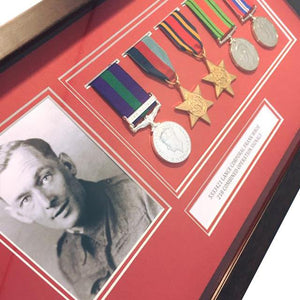
Display sets deserve the same care. A framed medal group should not simply be arranged to fit the aperture or to place the most attractive medal in the centre. Correct sequence remains the foundation. If badges, photographs, cap insignia or service records are being included, these should support the story of the group without altering the medal order itself.
For collectors, the issue is slightly different. A collector may own medals that were never worn together by one individual. In that context, display can be arranged by campaign, regiment or era. That is entirely acceptable as a collecting format, so long as it is not presented as an official wear group.
Some medal groups are straightforward. A single campaign medal needs no complex arrangement. Others are anything but simple. Mixed military and civilian awards, duplicate long service medals, reserve decorations, authorised foreign awards and rebuilt family groups all benefit from specialist checking.
That is particularly true where medals are being replaced with MoD Licensed Replica Medals or matched to original ribbons and clasps. Accuracy matters not just in sourcing the correct piece, but in placing it where it belongs within the group. Empire Medals regularly sees cases where the medals themselves are right, but the final sequence is not.
If the intention is respectful wear, restoration or preservation, a precise approach will always serve the medal group better than guesswork.
The correct order is more than regulation. It is part of the record. Whether you are wearing medals on parade, rebuilding a family group or preparing a framed presentation, careful attention to precedence ensures the story is told with the dignity it deserves.
Leave a comment