
Expert Support
Visit our Helpdesk
Visit our Helpdesk

A medal bar that sits unevenly on a jacket, ribbons cut to different depths, or campaign awards displayed in the wrong order will always look out of place. If you are deciding how to mount medals, the aim is not simply to make them tidy. It is to present them with the accuracy and respect they deserve, whether they are being worn on parade, kept as a family heirloom, or prepared for framing.
Mounting medals properly calls for more than a length of ribbon and a brooch bar. You need the correct order of wear, the right ribbon lengths, a sound fixing method, and an understanding of whether the medals are intended for active wear or static display. The best approach depends on the medals themselves and on how they will be used.
When medals are mounted for wear, the first question is whether they should be swing mounted or court mounted. Both methods are established, but they create a different look and suit different uses.
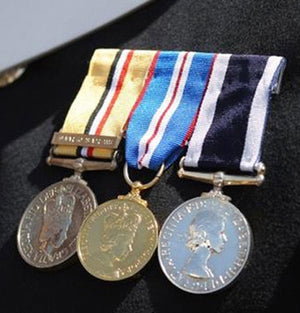
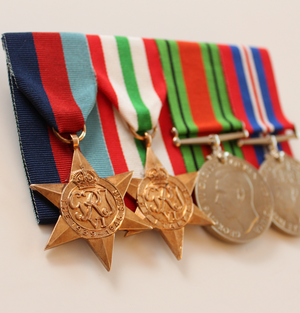
Swing mounting leaves the medals hanging freely from the brooch bar. This is the traditional style and is often preferred where a natural drape and movement are wanted. It suits some older groups particularly well and can feel truer to period presentation. The drawback is practical. Swing-mounted medals move against one another, can knock together, and are more likely to twist out of line during wear.
Court mounting fixes the medals onto a shaped backing so they sit in a neat, aligned row with the lower portion usually secured. This produces a cleaner appearance and is widely favoured for ceremonial use because the medals remain steady and presentable. Court mounting also offers better support where there are several medals in the group. The trade-off is that it is a more structured finish, and some collectors or veterans prefer the freer appearance of a swing-mounted group.
For parade wear, court mounting is usually the safer choice. For informal wear, historical authenticity, or where a particular regimental preference applies, swing mounting may still be appropriate. If there is any doubt, it is worth checking current dress expectations for the service or occasion.
Before any ribbon is cut, the medals must be arranged in the proper order of wear. This is one of the most important parts of the job and also the easiest place to go wrong. British campaign medals, coronation and jubilee medals, long service awards, and foreign decorations each follow recognised precedence.
A group may look convincing at first glance and still be incorrect if one medal has been placed ahead of another. That matters both ceremonially and historically. If you are mounting a single medal, this is straightforward. If you are mounting a mixed group built up over years of service, inherited from family, or assembled for collecting, accuracy becomes much more important.
Replica and replacement medals should also be checked carefully for size and style consistency. A badly matched ribbon shade or an incorrect suspender can spoil an otherwise well-mounted group.
Once the order is confirmed, each medal needs its correct ribbon. Full-size and miniature medals require different proportions, and the finished depth must be consistent across the whole group. Uneven ribbon lengths are one of the clearest signs of poor mounting.
The ribbons are folded over the mounting bar and shaped so the visible face is even across the set. On court-mounted groups, the ribbons are usually stretched neatly over a backing board. On swing-mounted groups, they are sewn so each medal hangs correctly and evenly from the bar. In both cases, the ribbon should be clean, sharp, and free from twists.
This stage often tests patience more than skill. Some ribbons are straightforward to fold and align; others are softer, older, or prone to fraying. If the medals are original and the ribbons are worn, replacement ribbon may be the better option for wear, while the original material is retained separately for provenance.
The backing bar does the hidden work. It supports the weight of the medals, keeps the row straight, and allows the finished group to sit correctly on clothing or within a display. If the bar is too light, too short, or badly balanced, the medals will not hang properly.
For wearable groups, a strong brooch bar with a reliable pin fitting is essential. The medals are attached in order, with enough overlap to create a neat row where necessary. In larger groups, overlap is standard and should be consistent. The left-to-right visual spacing must look deliberate rather than crowded.
On a court-mounted group, the medals are then secured onto the shaped mount so that the lower edges align cleanly. The mount should be firm but not bulky. On a swing-mounted group, the medals remain free, but they still need to sit evenly when at rest.
The aim is always the same: a balanced row that wears comfortably and looks correct from the front. That sounds simple, but heavy gallantry groups, mixed ribbon widths, and long medal bars can all complicate the finish.
Miniature medals follow the same principles as full-size awards, but the smaller scale makes accuracy more noticeable. A slight variation in ribbon depth or spacing can throw off the whole row. Miniatures are usually worn at formal evening functions and mess dress occasions, so the expectation is often for a particularly crisp finish.
Because they are lighter, miniatures are easier to support, but they can also appear untidy if mounted too loosely. Court mounting is common here for that reason. The finished group should be compact, level, and proportionate to the number of awards being worn.
If the miniatures are intended only for display in a case, there is more freedom in the backing method. Even so, the order of wear and ribbon accuracy should still be observed. Display does not remove the need for correctness.
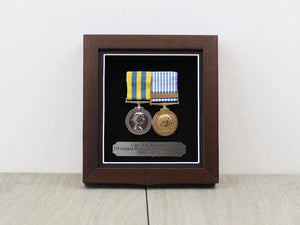
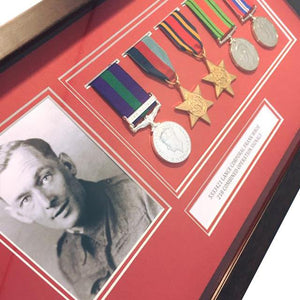
Not every medal group is going on a jacket. Many are mounted for framing, presentation cases, or family display. In these cases, wearability matters less than preservation and appearance.
Display mounting still starts with the correct order, but the method can be adapted to protect the medals and make the group more secure over time. The backing materials should be stable and sympathetic to the age of the medals. Adhesives should be avoided where they may damage ribbons or metal surfaces. A respectful display should allow the group to be viewed clearly without forcing the medals into an unnatural arrangement.
There is also a choice to make between restoration and retention of age. Some families want medals cleaned and ribbons renewed so the group presents sharply. Others prefer the wear, toning, and older ribbon folds to remain untouched. Neither choice is automatically right. It depends on whether the medals are being prepared for ceremony, conserved as historical objects, or presented as a commemorative piece.
Medals should never be polished aggressively before mounting. Over-cleaning can remove detail, damage patina, and reduce historical character. A careful clean to remove dirt and surface grime may be appropriate, especially if the medals have been stored badly, but it should be done with restraint.
Ribbons deserve the same caution. Fragile or faded ribbons can split during handling. In some cases, replacement ribbons are the practical answer for a wearable mount, while the originals are preserved separately. For collectors and families alike, keeping authenticity intact is usually more valuable than forcing a medal to look new.
Some medal groups are simple enough for an experienced hand to mount at home. A single medal or straightforward pair can be manageable if you have the right materials and know the required finish. Once the group becomes more complex, the margin for error narrows.
Professional mounting is usually worth considering where you are dealing with original medals, hard-to-find awards, larger overlapping groups, or a set intended for regular ceremonial wear. The same applies if the medals include a mixture of British and foreign awards, where precedence and spacing may be less familiar.
A specialist service also helps where consistency matters across full-size and miniature sets, or where the medals will go on to be framed, engraved, or prepared as a presentation piece. Empire Medals provides this kind of finishing work because a properly mounted group should look correct, feel secure, and stand up to close inspection.
The real value in professional work is not just neat stitching. It is judgement - knowing how much overlap is appropriate, when original ribbon should be retained, how to balance an awkward group, and how to preserve the character of the medals while presenting them properly.
If you are handling medals that mark service, sacrifice, or family history, mounting them well is part of treating them properly. Take the time to get the order right, choose the style that suits their use, and avoid quick fixes that will only need correcting later. A well-mounted group carries its story with the dignity it has earned.
Leave a comment