
Expert Support
Visit our Helpdesk
Visit our Helpdesk

For many veterans and families, Afghanistan campaign medals are not simply items of dress. They mark operational service in a conflict that stretched across years, units and theatres, and they often carry very personal weight. Getting the details right matters, whether you are replacing a lost medal, building a correct group, or preparing a set for wear or display.
In British terms, Afghanistan service is most commonly associated with two principal campaign awards: the General Service Medal 1962 with clasp NORTHERN IRAQ & SOUTHERN TURKEY is unrelated here, so for Afghanistan the key distinctions are the General Service Medal 1962 with clasp AFGHANISTAN for earlier qualifying service, and later the Operational Service Medal Afghanistan. That changeover is where many questions begin.
The broad point is simple enough. Different periods of service, and different rules in force at the time, determine which medal was awarded. If you are checking entitlement, replacing a missing piece, or matching a family medal group, the exact operational dates matter every bit as much as regiment, corps or branch.
For collectors, the same principle applies. Afghanistan medals may look straightforward at first glance, but accuracy depends on naming style, clasp entitlement, ribbon, and whether the medal should sit within a larger group that includes long service, Jubilee or NATO awards.
The General Service Medal 1962, usually shortened to GSM 1962, covered a range of campaigns across different decades. For Afghanistan, the relevant clasp was AFGHANISTAN. This award applies to qualifying service before the later Operational Service Medal became the standard campaign issue for the theatre.
This is one area where assumptions can cause problems. A veteran who served in connection with Afghanistan will not automatically have the same medal as someone deployed a few years later. If a medal group is being restored or replicated, the date of qualifying service must be checked carefully before ordering.
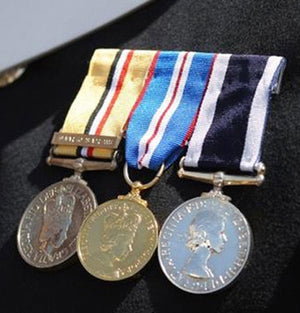
The Operational Service Medal Afghanistan, often called the OSM Afghanistan, became the principal campaign medal for later qualifying service connected with operations in Afghanistan. It is one of the most recognisable modern British campaign medals and is commonly seen mounted in full-size and miniature groups.
Within this award, clasp entitlement is especially important. Some recipients qualified for the medal alone, while others qualified for the medal with clasp AFGHANISTAN. From a collecting and presentation standpoint, that difference is not cosmetic. It is a formal part of the award and should be represented correctly on the medal and, where appropriate, through the ribbon arrangement.
With Afghanistan campaign medals, the clasp is often the detail that separates a broadly similar medal from a correct one. For wear, collecting or family preservation, this is not a minor point. A missing or incorrect clasp changes the medal from an accurate representation of service to something incomplete or misleading.
The same applies to ribbon bars and miniatures. If a full-size medal carries a clasp, the miniature version and the ribbon bar may also need to reflect that entitlement in the proper form. Buyers sometimes focus on the medal itself and only later realise that parade wear, mess dress miniatures or framed presentation all need to match.
That is why specialist advice is useful. A modern campaign group can involve the main medal, the correct clasp, matching miniature, replacement ribbon, mounting style and, in some cases, engraving or naming checks. Each part needs to align with the original award.
Not every customer is looking for the same thing, and this is where a specialist supplier is valuable. Some buyers need a respectful replacement for wear because the original medal is stored safely. Others want a collector example, a family display piece, or a replica to complete a historical presentation. Those are different requirements, and the right choice depends on purpose.
For practical wear and ceremonial use, MoD licensed replica medals offer a dependable route when originals are unavailable, too valuable to risk, or inappropriate for regular use. For many veterans and families, that balance makes sense. The original remains preserved, while a properly produced replica can be mounted for parades, reunions or remembrance events.
Collectors may weigh things differently. An officially named original medal group carries one sort of historical value, while a licensed replica offers presentation quality and consistency without claiming the same provenance. Neither option is inherently right in every case. It depends on whether the priority is research value, family commemoration, or correct ceremonial appearance.
The safest starting point is always service detail. Dates, unit, theatre, and whether the medal is for wear, replacement or display should be clear before any order is placed. This avoids the common problems of selecting the wrong medal issue or missing a clasp that ought to be present.
Naming is another point to consider. Some customers need unnamed replicas for display, while others are trying to match an existing named group as closely as possible within proper standards. The finish also matters. British-made, die-struck medals tend to provide the weight, detail and appearance expected by serious buyers, particularly where the medal will sit alongside original awards.
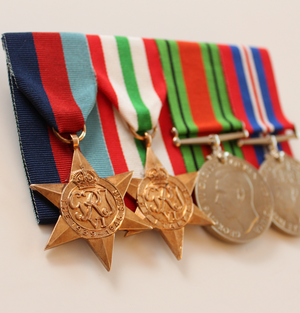
Then there is the broader group. Afghanistan service medals often do not stand alone. They may appear with Jubilee medals, long service awards, NATO medals, UN medals or earlier campaign awards. If the intention is to build a complete court-mounted group, the order of wear and spacing should be checked before mounting begins.
A well-made medal deserves proper finishing. Court mounting remains the preferred option for many veterans and ceremonial buyers because it provides a neat, secure and regulation-minded presentation for wear. It also protects the medals from unnecessary movement and helps create a cleaner line across a group.
Miniature mounting is just as important for mess dress and formal occasions. A mismatch between the full-size group and the miniature set is more common than it should be, particularly where clasps or later additions are involved. Having both prepared to the same standard avoids that problem.
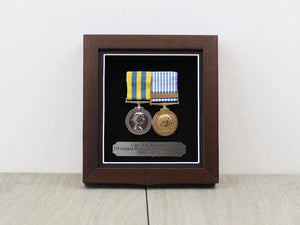
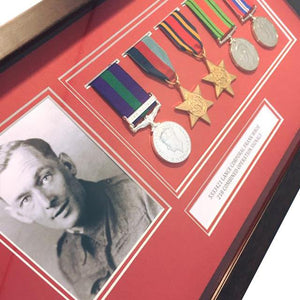
For family keepsakes, framing can be the better choice. A campaign medal from Afghanistan often sits best in a broader context with cap badge, photograph, service details or a short engraved plate. This is less about display for its own sake and more about preserving a story in a form that can be handed on.
Cleaning and restoration require a measured approach. Some medals benefit from careful professional attention, while others should be left largely as they are to preserve character and surface detail. Over-cleaning is a genuine risk, especially with older groups that include modern Afghanistan awards alongside earlier family medals. Good presentation should never come at the cost of authenticity.
The most frequent error is assuming all British Afghanistan service is represented by one medal. It is not. The second is overlooking clasp entitlement. The third is ordering a single medal without considering the rest of the group, miniature equivalents or ribbon requirements.
Another mistake is treating all replicas as equal. For a customer who values heritage and correct appearance, production quality matters. A poorly made medal can look out of place immediately when mounted next to British-made die-struck pieces. That is particularly obvious with modern campaign groups, where buyers often know exactly how the medal should sit, weigh and present.
Finally, there is the issue of provenance. If a medal is being purchased as a collector item rather than a wearing replacement, clarity is essential. An original named award, an unnamed original, and an MoD licensed replica each serve different needs. Confusing those categories leads to disappointment.
Afghanistan medals are not difficult to find in the broadest sense. Finding them correctly specified, well made and properly supported is another matter. A specialist supplier should be able to advise on medal type, clasp, ribbon, mounting and presentation without guesswork.
That level of support matters even more when dealing with inherited groups or partial sets. Families are often working from a photograph, an old box, or a handful of loose medals that need identifying and restoring into proper order. In those cases, product range and service capability need to sit together. Empire Medals works in that space, where accuracy, licensed replicas and finishing services all need to meet the same standard.
Afghanistan service remains close enough to the present that many medal groups are still being worn, not merely collected. That makes accuracy more than a matter of catalogue detail. It is part of showing proper respect to the service the medal represents. If you start with the right entitlement and finish with the right presentation, the result will look as it should and mean what it ought to mean.
Leave a comment